Dobbiamo immaginare come le cose potrebbero apparire da un
altro punto di vista
Le cose di cui ci occupiamo nella scienza si mostrano in una miriade di forme,
e con una moltitudine di attributi. Per esempio, se stiamo sulla spiaggia e guardiamo il
mare, vediamo l'acqua, le onde che si infrangono, la schiuma, il movimento
agitato dell'acqua, il suono, l'aria, il vento e le nuvole, il sole e il cielo
azzurro, la luce; c'è la sabbia, pietre di varie durezza e
stabilità, colore e consistenza.
Ci sono animali e alghe, fame e malattia, e l'osservatore sulla spiaggia; ci
possono essere perfino felicità e pensiero. Qualsiasi altro luogo in natura ha
una
simile varietà di cose e di influenze. E'
sempre così complicato, in qualsiasi luogo. La curiosità pretende che ci poniamo delle domande,
che cerchiamo di mettere le cose insieme e di capire questa moltitudine di aspetti come il
risultato, forse, dell'azione di un numero relativamente piccolo di cose e forze elementari che agiscono in
un'infinita varietà di combinazioni.
Il
senso dI TUTTE LE cose
… Questa libertà di dubitare è fondamentale nella
scienza e, credo, in altri campi. C'è voluta una lotta di secoli per
conquistarci il diritto al dubbio, all'incertezza: vorrei che non ce ne
dimenticassimo e non lasciassimo pian piano cadere la cosa. Come scienziato,
conosco il grande pregio di una soddisfacente filosofia dell'ignoranza, e so che
una tale filosofia rende possibile il progresso, frutto della libertà di
pensiero. E come scienziato sento la responsabilità di proclamare il valore di
questa libertà, e di insegnare che il dubbio non deve essere temuto, ma accolto volentieri in quanto possibilità di nuove potenzialità per gli esseri umani. Se
non siamo sicuri, e lo sappiamo, abbiamo una chance di migliorare la situazione. Chiedo la stessa libertà per le generazioni future.
il senso delle cose - fb/rf
Il
tema dei "culti del cargo" è stato anche il soggetto di un famosissimo
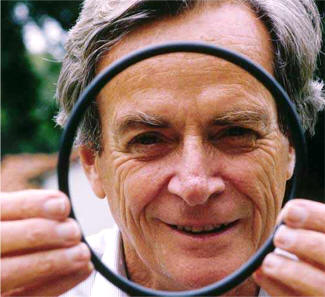
discorso tenuto dal grande fisico e scienziato statunitense Richard Feynman
all'apertura dell'anno accademico 1974 del Caltech. Feynman usò l'esempio dei
"cargo cult" per discutere di pseudoscienze e di metodo scientifico: ancora oggi
il discorso è considerato uno dei più chiari e appassionanti appelli ai valori
dell'integrità scientifica nella ricerca applicata.
kappero.com
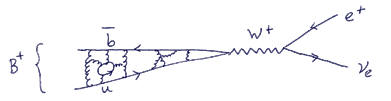
Weak Decay
Called a Feynman diagram, after Nobel physicist
Richard Feynman who originated them, this drawing by Steve Gottlieb starts on
the left with a B meson (B+). The strong force confines an up quark (u) and
bottom anti-quark () inside the B meson, where they interact until they
annihilate. "For a moment says Gottlieb, "there's a W boson (W+), carrier of
the weak force. Then that W boson, because it's a virtual particle, decays to an
anti-electron, also called a positron (e+), and an electron neutrino (_e)." psc.edu
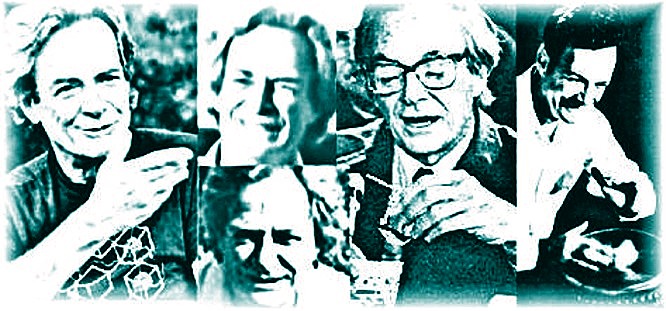
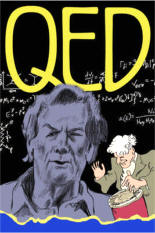
Nobelist Physicist
- teacher
- storyteller
- bongo player
di se' diceva - sono Fisico premio Nobel
- insegnante
- cantastorie -
suonatore di bongo
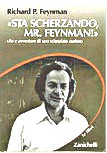
sta scherzando mr. feynman vita e avventure di uno scienziato curioso
titolo
originale - Surely You're Joking, Mr. Feynman! Un libro divertente, anticonformista e sincero, da leggere tutto d'un fiato che
ci trasmette la grande carica vitale di Feynman
con la sua enorme curiosità per ogni cosa. Feynman ci prende per mano e ci
spiega attraverso tanti
piccoli racconti la sua
filosofia di vita, la sua sete di conoscenza e il suo prorompente desiderio
di
esplorazione che non
risparmia niente e nessuno.
Nell'intreccio di aneddoti lo ritroviamo intento a riparare radio a valvole con
il pensiero oppure al traghettamento delle formiche che insidiano dispense o allo scassinamento delle casseforti di Los Alamos o a
suonare in una scuola di Samba o anche a risolvere mentalmente difficili problemi matematici e a
scrivere formule sulle tovaglie di carta di un topless bar.
Alla fine si è travolti dall'approccio entusiastico di Feynman: una sorta di
insegnamento a non dare nulla per scontato e che tutto può essere esplorato...
geocities.com/capecanaveral
I don’t know why but I’m always very careless,
when I go on a trip, about the address or telephone number or
anything of the people who invited me. I figure I’ll be met, or
somebody else will know where we’re going; it’ll get straightened
out somehow. One time, in 1957, I went to a gravity
conference at the University of North Carolina. I was supposed to be
an expert in a different field who looks at gravity. I landed at the airport a day late for
the conference (I couldn’t make it the first day), and I went out to
where the taxis were. I said to the dispatcher, ' I’d like to go to
the University of North Carolina . ' ' Which
do you mean ' he said ' the State University of North
Carolina at Raleigh or the University of North Carolina at
Chapel Hill ? ' . Needless to say, I hadn’t
the slightest idea. ' Where are they ?' I asked,
figuring that one must be near the other. ' one’s north of here, and the other is
south of here, about the same distance. ' I had nothing with me that showed which
one it was, and there was nobody else going to the conference a day
late like I was . That gave me an idea. ' Listen ' I
said to the dispatcher. ' The main meeting began yesterday, so
there were a whole lot of guys going to the meeting who must have
come through here yesterday. Let me describe them to you: They would
have their heads kind of in the air, and they would be talking to
each other, not paying attention to where they were going, saying
things to each other, like G-mu-nu. G-mu-nu. ' His face lit up. ' Ah, yes '
he said. ' You mean Chapel Hill ! ' He called the next
taxi waiting in line. ' Take this man to the university at
Chapel Hill. ' thank you ' I said, and I
went to the conference . surely you're joking m feynman e-reading.club
- gravitation : facebook.com/Feynman
1 - facebook.com/Feynman
2 - facebook.com/Feynman
3
cargo cult Sappiamo per esperienza che la verità finisce
col venire a galla. Altri scienziati ripeteranno il vostro
esperimento, e scopriranno se era corretto o no. I fenomeni della
natura coincideranno o no con la vostra teoria. E magari otterrete
una fama temporanea, ma se non avrete lavorato con molta accuratezza
la vostra reputazione di scienziato non sarà buona. Sono questa
integrità, questa volontà di non ingannarsi, che mancano alla
ricerca delle scienze da cargo cult.
Gran parte
delle difficoltà, per le scienze da cargo cult, dipendono
dall'argomento, dalla inapplicabilità dei criteri scientifici
all'argomento. Ma non sono le uniche difficoltà, questi sono i
motivi per cui gli aerei non atterrano, ma resta il fatto che non
atterrano. sta
scherzando mr. feynman - pag 340
vita e
avventure di uno scienziato curioso "Non un'autobiografia, no. Semplicemente una serie di aneddoti".
Così si riferiva Richard P. Feynman, premio Nobel per la fisica nel
1965, a questa sua prima collezione di episodi di vita, uscita negli
USA nel 1985 e inaspettatamente diventato un best seller nel giro di
poche settimane
In questi episodi la fisica è marginale, fa da coreografia, da set
teatrale, da messa in scena alla vita di un uomo, ancora prima che
dello scienziato. Il protagonista assoluto è lui, Feynman. Niente
formule, niente simboli. Niente conferenze dotte. Niente scienza,
dunque? Al contrario. Di scienza ce n'è molta, moltissima. Ma non
c'è scritto: raramente si parla o si descrive un fenomeno fisico. A
volte solo per poche righe, mai troppo importanti. Eppure ogni
pagina è intrisa di scienza: di scienza vissuta, perché in ogni
pagina c'è molto Feynman, lui, la persona e lo scienziato.
torinoscienza.it
Non so che cosa non va nella gente
non imparano usando l'intelligenza ma solo meccanicamente o giu' di
li
Il loro sapere e' cosi' fragile
sta scherzando mr feynman
everything I say is a lie everything I say is false
I love you ! :-)
Feynman singing to
a pretty girl at Esalen in Big Sur while drumming on the bongo.
stardrive.org
LIBRI
Genio
- La vita e la scienza di Richard Feynman
biografia - "enfant terrible" del progetto Manhattan, massimo
teorico della fisica quantistica, che al termine della sua vita e gravemente
malato, scoprì le cause del guasto che aveva portato all'esplosione della
navicella spaziale Shuttle.
libreriauniversitaria.it
HAWKINGsulla meccanica quantistica -
Einstein
... sbagliò quando disse: Dio non gioca a dadi.
La considerazione dei buchi neri suggerisce infatti non solo che Dio gioca a
dadi, ma che a volte ci confonda gettandoli dove non li si può vedere. -
attribuita
erroneamente anche a Richard Feynman
it.wikiquote.org
IL NUMERO
137
La costante di struttura fine è un numero magico
del quale non abbiamo alcuna comprensione
.
Fu Richard Feynman, infatti, a
suggerire che tutti i fisici affiggessero una targhetta nei loro uffici e nelle
loro abitazioni per ricordarci di quanto poco sappiamo . Sulla targhetta non ci
sarebbe stato altro che questo : 137. Ora, 137 è l’inverso di una cosa chiamata
"costante di struttura fine". Questo numero è in relazione con la probabilità
che un elettrone possa emettere o assorbire un fotone. La costante di struttura
fine risponde anche al nome di costante alfa, e corrisponde al quadrato della
carica dell’elettrone diviso per la velocità della luce moltiplicato per la
costante di Planck.L’unico significato di tale sproloquio è che questo numero,
137, contiene l’essenziale dell’elettromagnetismo (l’elettrone), della
relatività (la velocità della luce) e della teoria dei quanti (la costante di Planck) . Sarebbe meno sconvolgente se il rapporto tra tutti questi importanti concetti
risultasse pari a 1 o a 3 o, forse, ad un multiplo di p greco .
Ma 137 ?...
Dry spaghetti pasta, when bent beyond their limit curvature, dynamically break
into many fragments. This phenomenon has intrigued many authors, among which
Richard Feynman. In the book No Ordinary Genius
.
1994 -
Daniel W. Hillis describes his and Feynman's experiments
Once we were making spaghetti, which was our favorite thing to eat together … If you get a spaghetti stick and you break it, it will almost always break
into three pieces. Why is this true --- why does it break into three pieces? We
spent the next two hours coming up with crazy theories. We thought up
experiments, like breaking it underwater because we thought that might dampen
the sound, the vibrations. Well, we ended up at the end of a couple of hours
with broken spaghetti all over the kitchen and no real good theory about why
spaghetti breaks in three.
imm.jussieu.fr
In modo del tutto controintuitivo abbiamo scoperto
che il semplice rilascio dell’asta induce un aumento dello stress meccanico. La
rottura multipla delle aste piegate, come accade per gli spaghetti secchi, può
essere intesa quindi come una successione a cascata di rilasci - ossia perdita di
coesione dovuta a rotture - seguita da aumenti di stress che portano a nuove
crepe.
physical review letters 2005 - premio ignobel
sandro iannaccone - wired.it - magazine.daocampus.com -
galileonet.it - 2014
The physicist Richard Feynman, who famously dunked a
little O-ring in ice water and broke it
to demonstrate why the Space Shuttle
Challenger blew up in 1986, was fond of saying
the first principle is that you must not fool yourself
and you are the easiest person to fool
NON INGANNARE TE STESSO - SEI LA PERSONA PIU
FACILE DA INGANNARE
scoop.co.nz
Mi auguro riusciate ad accettare la natura per quello che è
assurda
Physics is like sex sure it may give
some practical result but that's not why we do it Non si può negare che il sesso abbia una
finalità pratica ma non è questo il motivo per cui di solito lo
si fa
It is our responsibility as scientists
to teach how doubt
is not to be feared but
welcomed and discussed
Richard
P. Feynman nobel lecture
I was delighted too when I heard about the Nobel Prize
thinking as you did that my bongo playing was at last recognised
It is
in the admission of ignorance and the admission of uncertainty that there is a
hope for the continuous motion of human beings in some direction that doesn't
get confined, permanently blocked, as it has so many times before in various
periods in the history of man.
the
meaning of it all
- p. 34
When a young
person loses faith in his religion because he begins to study science and its
methodology - it isn't that -
through the obtaining of real knowledge that - he
knows it all but he suddenly realizes that he doesn't know it all.
Scientific
views end in awe and mystery, lost at the edge in uncertainty but they appear
to be so deep and so impressive that the theory that it is all arranged as a
stage for God to watch man's struggle for good and evil seems inadequate.
in any
organization there ought to be the possibility of discussion... fence sitting is
an art, and it's difficult, and it's important to do, rather than to go headlong
in one direction or the other. It's just better to have action, isn't it than to
sit on the fence? Not if you're not sure which way to go, it isn't.
By honest
I don't mean that you only tell what's true. But you make clear the entire
situation. You make clear all the information that is required for somebody else
who is intelligent to make up their mind.
In case you are beginning to believe
that some of the things I said before are true because I am a scientist and
according to the brochure that you got I won some awards and so forth, instead
of your looking at the ideas themselves and judging them directly--in other
words, you have some feeling toward authority--I will get rid of that tonight.
I dedicate this lecture to showing what ridiculous conclusions and rare
statements such a man as myself can make. I wish, therefore, to destroy any
image of authority that has previously been generated.
rpfeynman .
When Richard Feynman’s mother Lucille heard that her
son, Richard, had been designated the Smartest Man In The World by a
magazine, her response was :
Our Richie ? The world’s smartest man
? God help us ! .
feynman.com
.
La mamma aveva un gran senso dell'umorismo e
diceva che le più alte forme di comprensione che possiamo raggiungere sono
la risata e la compassione umana . da : che ti interessa di ciò che dice la
gente ?
.
if computational systems are a natural consequence
of
physical law then a quantum computer
is not only possible but inevitable
it may take decades perhaps a century
but a commercially viable quantum computer is a certainty
For
a successful technology reality
must take precedence over public relations for Nature cannot be fooled
The real question of government
versus private enterprise
is argued on too philosophical
and abstract a basis
Theoretically planning may be good But nobody has ever figured out
the cause of government stupidity
and until they do (and find the cure)
all ideal plans will fall
into quicksand
The seven lectures that the
much-hailed Nobel Prize physicist Richard P. Feynman gave at
Cornell University in 1964 are now available online at
Microsoft Research.
Microsoft founder Bill Gates is among the legions of Feynman
admirers. In his introduction to Project Tuva, Gates says he
saw the lectures 20 years ago and thought, “Everybody ought
to see these because they make science interesting.” (Tuva
is a reference to Feynman’s long-time fascination with Tannu
Tuva, a small isolated region between Mongolia and Siberia.)
… fleshandstone.net
https://youtu.be/WOoJh6oYAXE - bill
gates : The Best Teacher I Never Had
2006 Deviazioni perfettamente ragionevoli
dalle vie battute
Don't You Have Time to Think?
2004
Sei PEZZI meno facili
2003-2005
Feynman Lectures on Physics
2002
Il piacere di scoprire
2001
La fisica di Feynman 1-2-3
2000
Sei PEZZI facili
1999
Il senso delle cose
1989
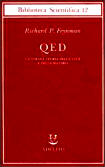
Qed. La strana teoria della luce
e della materia
1988
Sta scherzando Mr. Feynman!
1971
La legge fisica
unilibro.it
fb/rf
Addentrarsi nella vita
privata delle personalità pubbliche può essere un’esperienza
deludente, perché ciò che scopri può intaccare la tua ammirazione.
Con Richard P. Feynman non succede. Il suo epistolario Deviazioni
perfettamente ragionevoli dalle vie battute ... è pieno di belle
scoperte, non soltanto in campo scientifico ...
Si professava «totalmente ignorante in fatto di politica», ma ciò
non gli impedì di rifiutare diversi inviti a conferenze
internazionali organizzate in Unione Sovietica durante la guerra
fredda, motivando il diniego con la mancata concessione della
libertà di movimento agli scienziati russi. Esilarante il suo
tentativo, reiterato caparbiamente per anni, di uscire dalla
prestigiosissima National Academy of Sciences, non per un
atteggiamento snobistico, ma a causa di una reale insofferenza verso
l’autoreferenzialità di ilgiornale.it
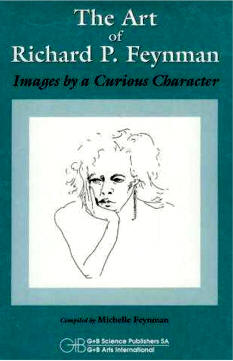
The Art of Richard P. Feynman
Images by a Curious Character
A collection of
the artwork of Richard P. Feynman
... Beginning with his earliest
drawings of the human figure in 1962 the book displays Feynman's
development of a personal artistic sensitivity to line form and the
moods of his subject as well as his experimentation with various
styles and media. produced over a 25 yearsperiod until 1987
.
michelle feynman - albert hibbs -
amazon 1995
We can't define anything precisely. If we attempt
to, we get into the paralysis of thought that comes to philosophers
... one saying to the other : you don't know what you are talking
about ! The second one says : what do you mean by
talking ? What do you mean by you ?
What do you mean by know ?
the feynman lectures on physics - 1963
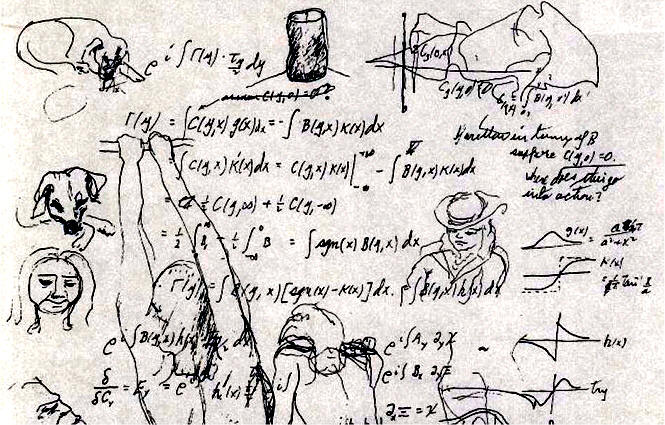
Drawings & Paintings
I
wanted very much to learn to draw, for
a reason that I kept to myself: I
wanted to convey an emotion I have
about the beauty of the world. It’s difficult to describe because
it’s an emotion. It’s analogous to the feeling one
has in religion that has to do with a god that controls everything
in the universe: there’s a generality aspect that you feel when you
think about how things that appear so different and behave so
differently are all run ‘behind the scenes’ by the same
organization, the same physical laws. It’s an appreciation of the
mathematical beauty of nature, of how
she works inside; a realization that the phenomena we see result
from the complexity of the inner workings between atoms; a feeling
of how dramatic and wonderful it
is. It’s - of scientific awe - which
I felt could be communicated through a drawing to someone who had
also had that emotion. I could remind him, for a
moment, of this feeling about the glories of the universe. openculture.com
I wanted very much to learn to draw, for
a reason that I kept to myself: I wanted to convey an emotion I have
about the beauty of the world. It's difficult to describe because
it's an emotion ...
fb/rf
what one fool can do
another can do better
si
conoscono molte più cose
di quante siano state dimostrate
dear
mrs. chown ignore your son's attempts
to teach you physics
physics isn't the most important thing
love is
best wishes richard feynman