il libro
che scriviamo sprigiona la nostra creatività rainews24
if there's a book that you want to read
but it hasn't been written yet
then you must write it se c'è un libro che vuoi leggere
ma non è stato ancora scritto allora devi scriverlo
.
quando ho
cominciato a leggere da scrittrice mi sono resa conto di un aspetto
ovvio: il soggetto del sogno è il sognatore. la costruzione di un
personaggio "africanista" è riflessiva : una straordinaria
meditazione sul proprio io. una vigorosa esplorazione delle paure e
delle bramosie che risiedono nella coscienza di chi scrive.
Scrivo ancora prima
dell'alba. Giro le spalle a panorami
naturali troppo attraenti, prendo matita e blocchetto e rimango lì,
completamente sola: io e la
mia scrittura .
Le parole quando compongo scorrono lentamente. Ci presto molta
attenzione, il ritmo deve essere quello giusto per la lettura.
Rileggo infinite volte ciò che scrivo per far sì che tutto sembri
nato senza sforzo.
festivaletteratura 2004 e 2012
- intervista di luciano minerva -rainews24.it -
teche.rai.it/toni-morrison
-
video
.
Scrivere è un processo lungo
e costante di lettura. Leggere è un atto di resa,
ci si arrende perché si entra completamente in un mondo immaginario .
E’ profondamente stimolante, richiede di usare la propria
immaginazione: esattamente la qualità che non è richiesta quando si
guarda la televisione, perché lo schermo ti dà già tutto, i colori,
i suoni, i dialoghi, l’immagine. In un libro siete voi che lavorate,
così si allarga il vostro pensiero, la vostra immaginazione e questo
aumenta la vostra capacità di essere persone creative nel mondo . teche.rai.it/toni-morrison
.
sometimes ideas arrive
through reading contradictory things in history books or newspapers
- sometimes it's a response or reaction to current events .
But that only explains where some of the themes come from . I can't explain inspiration .
A writer is either compelled to write or not . And if I
waited for inspiration I wouldn't really be a writer . . on where she finds inspiration - time magazine - january 21,
1998
.
Writing novels is the world to me . The outside
world can be OK or not OK, beautiful
or not beautiful, but I am in control
here .
When I'm writing, nobody's telling me what to do .
The expectations are high because they are mine and that is a kind
of freedom I don't have anywhere else . Nowhere.
. Morrison still scratches out the first drafts of her novels with a
pencil on yellow legal pads. dan white -
santacruzsentinel.com - fb/tm
.
I recognize failure
-
which is important - some
people don’t - and fix it, because it is
data, it is information, knowledge of what does not work . NEA Arts Magazine about failure
.
NO PLACE FOR SELF-PITY
- NO ROOM FOR FEARIN TIMES OF DREAD
- ARTISTS MUST NEVER CHOOSE TO REMAIN SILENT . the nation magazine
.
It's not profound regret.
It's just a wiping up of tiny little messes that
you didn't recognize as mess when they were going on . npr.org
. The writing is
- I'm free from pain. It's the place where I live
- it's where I have control -
it's where nobody tells me what
to do - it's where my imagination is
fecund and I am really at my best . Nothing matters more in the world or in my body or anywhere
when I'm writing . npr.org
.
did you write in the middle of
the night? early in
the morning, that’s when I’m really smart, now I’m getting
little dumb but early in the morning I am on it. I get up before the
sun, I do my work until about noon . nadifa mohamed
- lithub.com
.
You have to be a little
tough, and rely on yourself .
And tell people No
.
fb/tm
.
I am trying to write less that means more,
that says more . For me it is extremely important .
For the clarification, not only of the past, but of who we are
as human beings .
fb/nobelprize
All my books were
questions for me says Morrison . I wanted to know what would
happen if ... ? What do friendship and love mean under those
circumstances ? How far would you go ? I don't want to write about
normality, but when there's a cataclysm and conflict in belief, a
complexity of emotion and behaviour .
The question was posed, as though it were
a desirable thing to do, to write about white people or to
write ' not write about race ' that's what that
means to me. And that it was more difficult to do, a
higher level of artistic endeavor, or it was more
important and that I was still writing about marginal
people ... as though our lives have no meaning and no depth
without the white gaze . And I've spent my entire
writing life trying to make sure that the white gaze was not the
dominant one in any of my books . tm in conversation with charlie rose
1998 - academia.edu
.
I’ve never been
interested or impressed by evil itself But I have been
confounded by how attractive it is to others and stunned by the
attention given to its every whisperits
every shout.
Evil has a
blockbuster audiencewhile goodness
lurks backstage. toni
morrison gave the 2012
harvard divinity
school ingersoll
lecture and focused on altruism and the
literary imagination
harvardmagazine.com
I TAKE THIS SERIOUSLY AS A SCHOLAR
AND A WRITER because the Society can track what is going
on with literature-with its reception, with the ways in
which it is read, with the way in which it is understood
and its impact on other cultures everywhere. The society
can foster an interest in and be the clearing house for
a whole new world of literature, which includes many,
many people.
Toni Morrison - Chartering Ceremony of the Toni Morrison
Society
April 24, 1995
The
Toni Morrison Society was founded in 1993 at the
annual meeting of the American Literature Association in
Baltimore. The group was organized by Carolyn Denard,
than an associate professor of English at Georgia State
University. Professor Denard who is the chair of the
society’s board, stated, “We think Oberlin is a perfect
home for the Toni Morrison Society. Its distinctive
history in the lives of African Americans and women, its
commitment to the humanities, its renowned Conservatory
of Music, and its place in Toni Morrison’s life and works intersect on so many levels with the society’s
mission and programs. We hope that the society’s presence on Oberlin’s campus will complement the really
fine work going on here and that it will allow us to
expand our reach within the region and internationally.
It’s a great move for us, and we are pleased and excited
to be joining the Oberlin community.”
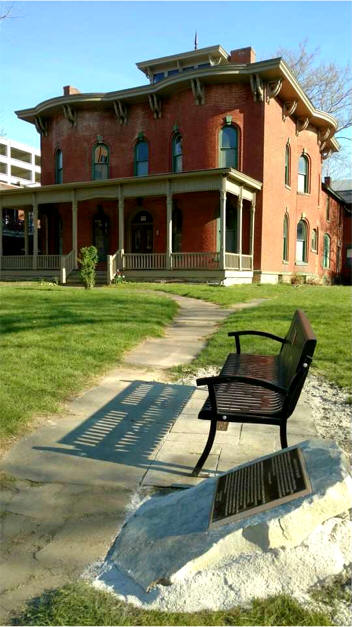
In addition to encouraging the scholarly study of
Morrison’s works, the society has established the “Bench
by the Road Project,” which places memorial markers in
important locations in African American history in the
United States and abroad. During a visit to Oberlin in
2009, Morrison joined society members in dedicating a
bench to the memory of the enslaved men, women, and
children who followed the Underground Railroad to
Oberlin .
jbhe.com - facebook/tonimorrison
I think long and carefully about what my novels ought to
do
They should clarify the roles that have become obscured
they ought to identify those things in the past that are
useful
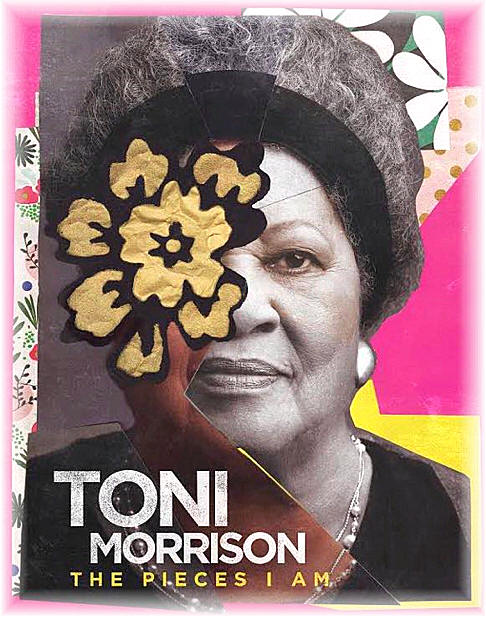
novelist - photographer - documentarian Timothy
Greenfield-Sanders In the docu, she reflects on her lifelong deconstruction of the
master narrative.
Woven together with
a rich collection of art, history, literature and
personality, the film includes discussions about her
many critically acclaimed works, including celebrated
novels The Bluest Eye, Sula and Song of Solomon.
She also talks about her role as an editor of iconic
African-American literature and her time teaching at
Princeton University. dino-ray ramos -
deadline.com
- clip
- 2019 - versione teatrale
da giugno 2019
It's impossible to
actually imagine the American literary landscape without
a Toni Morrison oprahmag.com
- 2019
Toni
Morrison's work shows us through pain all the myriad
ways we can come to love oprah winfrey - 2019
So - painful - so deep, for an 11 year-old girl to
believe that if she only had some characteristics of the
white world, she would be okay .
...
Navigating a white, male world wasn’t threatening .
It wasn’t even interesting . I was
more interesting than they were, and I wasn’t afraid to
show it .
...
I didn’t want to speak for
black people . I wanted to speak to
and to be among . It’s us .
facebook.com/ToniMorrisonFilm/videos
-
the pieces i am - fb/tm
The Bench b
y the Road Project is a memorial history and
community outreach initiative of the Toni Morrison
Society. The Project was
launched on February 18, 2006, on the occasion of Toni
Morrison's 75th Birthday. There is no place you or I can
go, to think about or not think about to summon the
presences of or recollect the absences of slaves ...
There is no suitable memorial or plaque or wreath or
wall or park or skyscraper lobby. There's no 300-foot
towerthere's no
small bench by the road. There is not even a tree scored
an initial that I can visit or you can visit in
Charleston or Savannah or New York or Providence or better still on the banks of the Mississippi.
And because such a place
doesn't exist ... the book had to . the world 1989 - tonimorrisonsociety.org
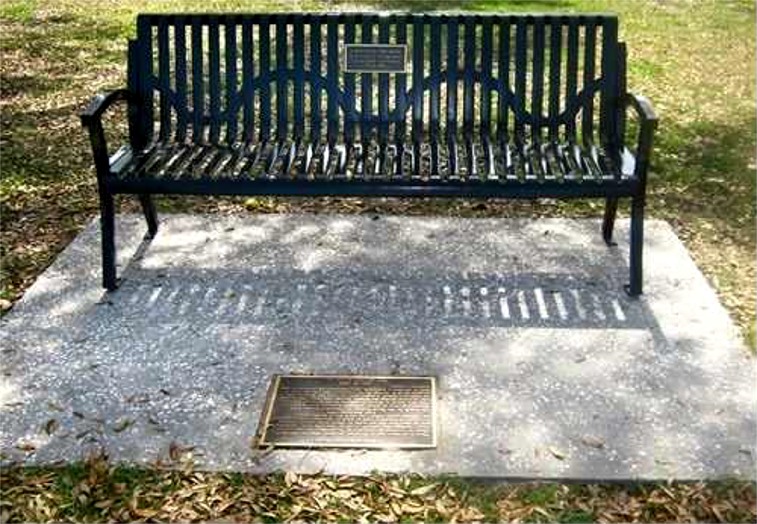
- fb/tm 2016 This is the first
' Bench by the Road ' - It
was placed in memory of the thousands of slaves who were
brought through Sullivan’s Island – the entry point for
nearly half of all captive Africans shipped to North
America. The bench is located on the grounds of the Fort
Moultrie Visitor Center. fb/tm - 2014
This will be the first 'Bench by the Road' in the New
York metro area.Morrison said this bench, so near to her home,
was meaningful to her.'I
was in places like Paris and Martinique to visit the
benches, but I have to say this particular bench
placement to commemorate the life of Cynthia Hesdra, in
my neighborhood, is really profound'
.
usatoday.com - 2015 the bench installed in
front of the historic Cozad Bates https://youtu.be/vmG7R8tjK_k
- 2016
The Toni Morrison Society’s Bench by the Road Project is
delighted to announce the upcoming placement of our 25th Bench and Historic
Plaque,
commemorating the distinguished history of Howard
University.
tonimorrisonsociety.org -
newsroom.howard.edu/25th-bench-road-honor
- 2019
le strade dell'Ile dela Cité a Parigi
sono state ribattezzate con nomi di donne celebri . tra
queste Toni Morrison . ansa - 2015
TONI MORRISON DAY - 8 MAGGIO 2012 -
PRIMO RIOT READING DAY *
Toni Morrison Among Brooklyn Museum's First
Awards Honorees The prizes will recognize 15 women who were
first in their fields theatermania.com - 2012
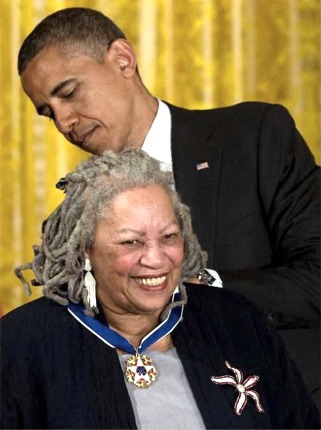
2012 Medal
of Freedom Honorees
President Barack Obama
named thirteen
recipients of the Presidential Medal of Freedom. The Medal of
Freedom is the Nation’s highest civilian honor, presented to
individuals who have made especially meritorious contributions to
the security or national interests of the United States, to world peace, or to cultural or other significant public or private
endeavors. Toni Morrison
One of our nation’s most celebrated novelists, Morrison is renowned
for works such as Song of Solomon, Jazz, and Beloved, for which she
won a Pulitzer Prize in 1988.
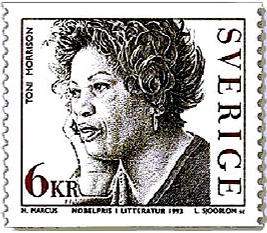
When she became the first African
American woman to win a Nobel Prize in 1993, Morrison’s citation
captured her as an author “who in novels characterized by visionary
force and poetic import, gives life to an essential aspect of
American reality.”
She created the Princeton Atelier at Princeton
University to convene artists and students. Morrison continues to
write today.
whitehouse.gov - 2012
- Right around my first year of college – I
remember ‘Song of Solomon’, by Toni Morrison, just moved me
tremendously. The power of language and how it can peel back truths,
bring things to the surface. - BARACK OBAMA fb/nobelprize - 23.4.2018
In a statement, Obama described Morrison as an author “who in novels
characterized by visionary force and poetic import, gives life to an
essential aspect of American reality.”
afro.com - 2012 La medaglia presidenziale, che sara' conferita
alla Casa Bianca, e' la piu' importante onoreficenza civile degli
Stati Uniti, ed e' destinata ogni anno a personalita' che hanno dato
un contributo speciale per la pace nel mondo, per la sicurezza e gli
interessi nazionali degli Stati Uniti, o anche per l'impegno nella
sfera pubblica o privata. repubblica.it
Toni Morrison Day ... Miller and Howse want
Morrison's birthday, Feb. 18, to be designated as "Toni
Morrison Day" in Ohio.
Their bill is now en route to the House Rules and
Reference Committee and should get a committee
assignment soon ... In the Lorain area, Toni
Morrison has long been a source of inspiration for our
youth - said Rep. Miller -
... I am hopeful that the designation of Toni Morrison
Day will remind all Ohioans to learn from the body of
work that inspired so many during her lifetime. sam
allard citybeat.com -
fb/thetonimorrisonsociety - 27.8.2019
Starting Feb. 18, the birthday of one of America's great
writers, will be known as Toni Morrison Day in Lorain.
morningjournal.com - fb/tm - 5.9.2019
vi racconto la lingua che
fornisce riparo ai despoti Quando la mistificazione
della vita quotidiana è completa, non c’è niente di
nuovo o di contemporaneo nelle notizie. Pur essendo
aggiornate al minuto, diventano arcaiche, moribonde e
irreali come una penna d’oca, si lasciano sfuggire il
futuro per custodire la privazione .
-tm
ilsole24ore.com/art/toni-morrison
- 2020
There is no civilisation
that did not begin with art
Whether it was drawing a
line in the sand
painting a cave or
dancing fb/tm
In an interview,
Toni Morrison identifies Nadine Gordimer
1923-2014, Lillian Hellman, and
Eudora Welty as among her favorite writers: "Perhaps it is because
they are all women who have lived in segregated areas of this
country or in an area where there is apartheid. They are fearless.
Nadine Gordimer and Eudora Welty write about black people in a way
that few white men have ever been able to write. It's not
patronizing, not ROMANticizing--it's the way they should be written
about." In another interview, Morrison states "Nadine Gordimer
writes about black people with such astounding sensibilities and
sensitivity--not patronizing, not ROMANtic, just real. And Eudora
Welty does the same thing. Lillian Hellman has done it. Now, we
might characterize these women as geniuses of a certain sort, but if
they can write about it, it means it is possible.
They didn't say,
'Oh my God,
I can't write about black people' - it didn't stop them' ...
www2.gsu.edu
- Tolstoy doesn’t write books for girls in
Lorain, Ohio. He just writes books, and he assumes all these things
.
-
African American writers, they
all seem to be needing to be persuading or confronting white men.
- I didn’t have to
glorify or demonize. I could just write
about complicated people.
Richardson Auditorium - Princeton - prof Claudia Brodsky nj.com - 2014
It’s important, therefore, to know who
the real enemy is, and to know the function, the very serious
function of racism, which is distraction. It keeps
you from doing your work. It keeps you explaining over and over
again, your reason for being. Somebody says you have no language and
so you spend 20 years proving that you do. Somebody says your head
isn’t shaped properly so you have scientists working on the fact
that it is. Somebody says that you have no art so you dredge that
up. Somebody says that you have no kingdoms and so you dredge
that up . lecture at portland
state university’s oregon public speakers collection - 30.5.1975
only American-only African-Americans were not immigrants in this
rush to find a heaven. They had left a home. So they're seeking for
another home, while other people are doing the same thing, except
the other people were leaving a home that they didn't want to be in
any longer, or couldn't be in any longer. Native Americans were
being moved around in their home. African-Americans were looking for
a second one and hopefully one that would be simply up to them,
their own people, their own habits, their own culture, and to
contain themselves in that. So it makes the motive for paradise a
little bit different.
pbs.org/wnet/americannovel/timeline/morrison.html
There is no such things
as race
- said
Morrison. Racism
is a construct - a social construct. And it has benefits.
Money can be made off of it. People who don’t like themselves can
feel better because of it. It can describe certain kinds of behavior
that are wrong or misleading. So - racism - has a social function. But
race can only be defined as a human being.
yolanda sangweni - essence.com
GHOSTS IN THE HOUSE
HOW TONI MORRISON FOSTERED A GENERATION OF BLACK WRITERS. BEING A BLACK WOMAN WRITER IS NOT A SHALLOW
PLACE TO WRITE FROM - IT DOESN’T LIMIT MY IMAGINATION; IT EXPANDS
IT. ...You know, my
sister Lois was just here taking care of me,” she said. “I had a
cataract removed in one eye. Suddenly, the world was so bright. And
I looked at myself in the mirror and wondered, Who is that woman?
When did she get to be that age? My doctor said, ‘You have been
looking at yourself through the lens that they shoot Elizabeth
Taylor through.’ I couldn’t stop wondering how I got to be this age.
...I read books. I teach books. I write books. I
think about books. It’s one job. hilton als - newyorker.com
2003 - fb/tm
In this country American means white. Everybody else has to
hyphenate
«è una questione di razza, è ancora una
questione di razza». Mette in guardia dalla comunicazione televisiva, dalla gara
all'ultimo voto che dice è per voi, è per il pubblico del mondo
divertito da percentuali luminose e cartine colorate, in molti casi
ignaro o disinteressato allo scontro mediatico in un incontro
determinante nella vita degli Stati Uniti. L'incontro tra potere
soldi. E razza.
Il suo paese ancora la preoccupa.
«In queste prossime elezionipiù che
mai la questione della razza è utilizzata come terreno di falsa
divulgazione per l'opposizione Repubblicana che ha organizzato una
campagna elettorale contro il Presidente Obama e la "sua gente" facendo levaancora su un diffuso e bianco sentimento nostalgico» veronica costanza ward - il sole24ore
reviving stories of African-Americans
brutalized in the 20th century - Princeton University ‘goodness’ more powerful than
violence, hate...
Morrison said that brutal violence against African-Americans was so
commonplace throughout much of the 20th century that it was almost
casual how it came to shape their lives in that era. “Each is a
story of humiliation of degradation and very often of blood” said
Morrison. “To revive these stories, to put them on display, is
almost as important as the original justice could have been.”
“Little black girls were never taken
seriously in books, they were always
jokes” Morrison said. “But I wanted to read a book where they were
taken seriously, so I had to write it.”
Reflecting on Martin Luther King Jr’s legacy of nonviolence
Morrison suggested that the Civil Rights era was about much more
than the simple hope for a brighter future.
northeastern.edu - facebook/morrison
As a college student
in Washington, in the 1950s, Toni Morrison said she was confused by
segregation.
She thought people were kidding when they told her the rules: she
couldn't sit in certain places, drink from certain fountains or try
on hats in the department store, she said. "It
was sort of odd," said Morrison, 83, and a Pulitzer Prize winner and
Nobel laureate.
santa cruz's rio theatre -
Peggy Downes Baskin Ethics Lecture
kara guzman - santacruzsentinel.com
Your imagination is more powerful than the
rage
It really is ... The rage is just 'whoosh'
but then there's this other thing
I'm calling it knowledge here but it really
is imagination. fb/tm
anche nell'america di
obama l'eguaglianza è un miraggio
... per i neri la razza
conta ancora e serve ad affossarci lastampa
No longer are we pioneers... No, we are multitudes
And society is clearly
the better for our peaceful invasion the women's
list
Toni Morrison receives an doctor of literature honorary degree
during Princeton University's 266th
commencement.
"In prose that is elegant, spare, deeply learned, and redolent with
the cadences of colloquial speech, she reanimates and reframes the
past through stories of the aspirations and losses, desires and
despair of those who have been written out of history," David
Offensend, the university orator and a Princeton trustee, said of
Morrison as her degree was awarded.
kelly heyboer - nj.com
But Morrison is nothing if not canny
Brandishing the fact of slavery and
playing on America's collective shame, Morrison has cowed her
would-be critics. We know that horrors as bad or worse than any she
describes actually happened. (Morrison's inspiration for Sethe was
an escaped slave named Margaret Garner, who is the subject of Steven
Weisburger's new book, "Modern Medea.") But this is history as
bludgeon, perfectly captured by the novel's dedication: "Sixty
Million and more (the figure denoting the Africans who died on the
middle passage). As Stanley Crouch pointed out in his withering
essay on the book, 60 is 10 times six. In Morrison, we are dealing
with a writer who measures suffering by numbers.
http://dir.salon.com
When
slavery has torn apart one's heritage,
when the past is more real than the present, when the
rage of a dead baby can literally rock a house, then the traditional
novel is no longer an adequate instrument. And so Pulitzer
Prize-winner Beloved is written in bits and images, smashed like a
mirror on the floor and left for the reader to put together. In a
novel that is hypnotic, beautiful, and elusive, Toni Morrison
portrays the lives of Sethe, an escaped slave and mother, and those
around her. There is Sixo, who "stopped speaking English because
there was no future in it and .... Baby Suggs, who makes her
living with her heart because slavery "had busted her legs, back,
head, eyes, hands, kidneys, womb and tongue;" and Paul D, a man with
a rusted metal box for a heart and a presence that allows women to
cry. At the center is Sethe, whose story makes us think and think
again about what we mean when we say we love our children or freedom.
The stories circle, swim dreamily to the surface, and are suddenly
clear and horrifying. Because of the extraordinary, experimental
style as well as the intensity of the subject matter, what we learn
from them touches at a level deeper than understanding. Review by Erica Bauermeister:
From 500 Great Books by Women.
luminarium.org
Il mio lavoro mi costringe a riflettere come scrittrice afro
americana
in un mondo determinato dalle
categorie di genere sesso e razza giochi al buio
I’m writing for black
people … I don’t have to apologise theguardian.com
Nella mia vita ho assistito a cambiamenti
importanti
ma le questioni razziali non sono una cosa
superata
Nonostante negli Stati Uniti ci sia un presidente
nero come Barack Obama
I am a
writer and my faith in the world of art is intense but not irrational
nor naïve - because art takes us and makes us take a journey beyond
price beyond cost into bearing witness to the world as it is and as it
should be.
Art invites us to know beauty and to solicit it summon it from even the
most tragic of circumstances.
2013 Vanderbilt University graduation
.
The Work You Do -
the Person You Are The pleasure of being
necessary to my parents was profound ... . In any case, he put down his cup of coffee
and said, 'Listen. You don’t live there. You live here. With your
people. Go to work. Get your money. And come on home' . That was what he said. This was what I heard: 1. Whatever the work
is, do it well - not for the boss but for yourself 2. You make the job - it doesn’t make
you 3. Your real
life is with us, your family 4. You are not the work you do - you
are the person you are ...
tm - newyorker.com
I knew how to scrub floors on my knees and how to wash clothes in
our zinc tub, but I had never seen a Hoover vacuum cleaner or an
iron that wasn’t heated by fire.
fb/nobelprize - 2017
.
La nuova narrativa?
Narcisista. Gli scrittori parlano solo di sé.
basta.
... Sui social media
oggi non corre assolutamente nulla di culturalmente e socialmente
rilevante, ma solo fiumane oceaniche di gossip personali, blurb
stupidi, slang effimeri. In altre parole: è un universo fermo dove non succede mai nulla.
Da che mondo è mondo la scrittura richiede solitudine e
concentrazione. Per quanto mi riguarda scrivo ancora tutti i miei
libri a matita su un bloc notes giallo e solo alla fine li trascrivo
al computer
alessandra farkas - lettura.corriere.it
Toni Morrison cancels memoir contract due to 'not interesting' life
she was asked if she intended to write an autobiography about her
childhood in the area, and admitted that she had gone so far as to
sign a contract for her next book to be a memoir. "But then I cancelled it," she said.
"My publisher asked me to do it, but there's a point at which your
life is not interesting, at least to me.
I'd rather write fiction."
"People say to write about what you know," she told students in
Oberlin. "I'm here to tell you, no one wants to read that, cos you
don't know anything. So write about something
you don't know. And don't be scared, ever."
alison flood - theguardian.com
Mi sembrò subito un uomo singolare e diverso
da tutti gli altri. Non mi era mai
capitato di trovarmi di fronte a un tipo tanto saggio, erudito e
insieme forte, duro e coraggioso. Emanava un vigore fisico e morale
quasi soprannaturale. Il modello di Mandela e quello di
Martin Luther King hanno influenzato in
maniera profonda la politica americana e l’elezione di Obama.
Parlo del simbolo.
altruisti che hanno rischiato tutto sfidando le
gerarchie razziali e usando il potere non per se stessi ma per
cambiare il mondo. Sono loro i semi che hanno fatto germogliare il
fiore della nuova America.
alessandra farkas -
27esimaora.corriere.it
ON PRIMO LEVI Language is the gold he mines to
counter the hopelessness of meaningful communication between
prisoners and guards. An example of this is the exchange, recounted
in If This Is a Man, between himself and a guard when he breaks off
an icicle to soothe his thirst. The guard snatches it from his hand.
When Levi asks why, the guard answers:
“There is no why here.” While the
oppressors rely on sarcasm laced with cruelty, the prisoners employ
looks and glances to gain clarity and meaning. Although photographs
of troughs of corpses stun viewers, it is language that seals and
reclaims the singularity of human existence.
tm - theguardian.com
Martin Luther King
didn’t have any guns, he didn’t blow up
anything, he didn’t lynch anybody. He trained boys and girls to
just sit there and accept insults. That is a thing that is bigger
than hope. It is survival and it is resistance and it is triumph.
TM in a talk at northwestern university in 2013
- fb/tm
sarah: make america great again. Make America Great
Again means ‘Make America White Again.’ So now you have this
other explosion of people who want to feel above something, better
than something. And who is that? That’s me. mario:
what will your next book be about ? Oh, it’s so good! It’s called Justice,
although it’s not about justice. There’s a family in there,
and their slave owner. His name was Goodmaster, and he made all the
slaves call themselves Goodmaster. They hated it because he was
horrible, but they kept the name because they could keep in touch
with each other generations later. There’s a guy in there who has
three children, two girls and a boy. Their names are Courage,
Freedom and Justice, but that’s not good when they go to school. So
instead of Courage, they write Carrie. And Freedom, they say Frida.
And the boy, whose name is Justice, they call Juice. Names matter.
The naming is vital because we didn’t have any names. They just gave
us stupid names. I tried to remember my father’s friends. They had
nicknames. Cool Breeze, and one was called Jim the Devil. All kinds
of names. Some are lovely, some are horrible. Whatever your weakness
is, that’s what they call you. So you can get that out of the way.
interview - granta.com - mario keiser - sarah ladipo manyka - fb/tm
- 2017
definitions belong to the definers - not the
defined fb/tonimorrison
The visionary language of the doomed reaches heights
of linguistic ardor
with which language of the blessed and saved cannot
compete
fb/tmsociety - 2020
 hat
means to me. And that it was more difficult to do, a
higher level of artistic endeavor, or it was more
important and that I was still writing about marginal
people ... as though our lives have no meaning and no depth
without the white gaze . And I've spent my entire
writing life trying to make sure that the white gaze was not the
dominant one in any of my books .
hat
means to me. And that it was more difficult to do, a
higher level of artistic endeavor, or it was more
important and that I was still writing about marginal
people ... as though our lives have no meaning and no depth
without the white gaze . And I've spent my entire
writing life trying to make sure that the white gaze was not the
dominant one in any of my books .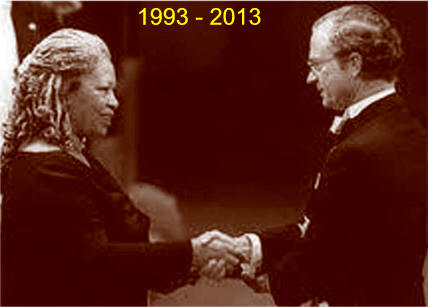
 iation in
Baltimore. The group was organized by Carolyn Denard,
than an associate professor of English at Georgia State
University. Professor Denard who is the chair of the
society’s board, stated, “We think Oberlin is a perfect
home for the Toni Morrison Society. Its distinctive
history in the lives of African Americans and women, its
commitment to the humanities, its renowned Conservatory
of Music, and its place in Toni Morrison’s life and works intersect on so many levels with the society’s
mission and programs. We hope that the society’s presence on Oberlin’s campus will complement the really
fine work going on here and that it will allow us to
expand our reach within the region and internationally.
It’s a great move for us, and we are pleased and excited
to be joining the Oberlin community.”
iation in
Baltimore. The group was organized by Carolyn Denard,
than an associate professor of English at Georgia State
University. Professor Denard who is the chair of the
society’s board, stated, “We think Oberlin is a perfect
home for the Toni Morrison Society. Its distinctive
history in the lives of African Americans and women, its
commitment to the humanities, its renowned Conservatory
of Music, and its place in Toni Morrison’s life and works intersect on so many levels with the society’s
mission and programs. We hope that the society’s presence on Oberlin’s campus will complement the really
fine work going on here and that it will allow us to
expand our reach within the region and internationally.
It’s a great move for us, and we are pleased and excited
to be joining the Oberlin community.”