|
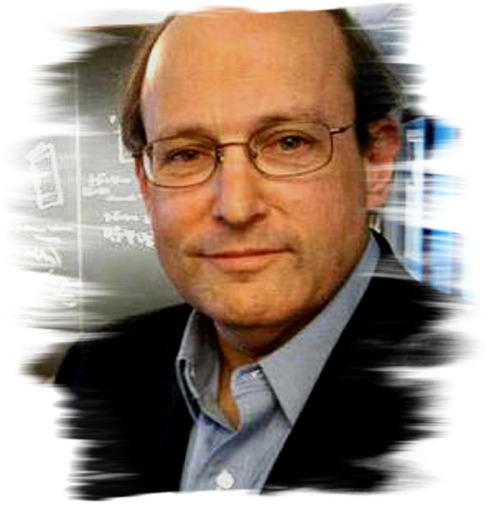
Paul J. Steinhardt is the Albert
Einstein Professor of Science at Princeton University. Director, Center for
Theoretical Science He is on the faculty of both the Department of Physics and
the Department of Astrophysical Sciences.
Steinhardt is one of the architects of the "inflationary model of the universe."
This is a
modification of the standard Big Bang picture, which proposes a brief period of
extraordinary, superluminal
expansion in the early universe to explain the homogeneity and large-scale
structure of the universe.
He and collaborators constructed the first successful model and then showed how
quantum fluctuations g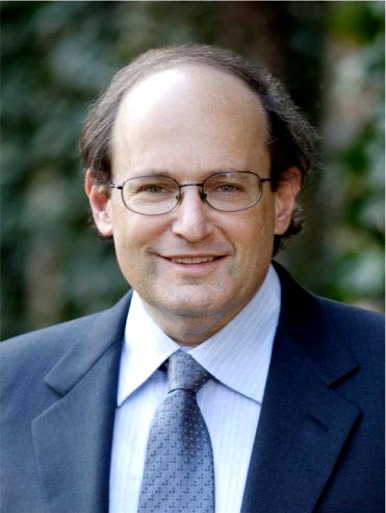 enerated during inflation may seed the formation of
galaxies and also produce
temperature variations in the cosmic microwave background.
In the last year, Steinhardt and Neil Turok (Cambridge University) proposed a
radical alternativethe cyclic universe." In this scenario, the universe avoids inflation and
instead, undergoes an
infinite time in the past and the future, going through an endless sequence of
bangs and crunches. enerated during inflation may seed the formation of
galaxies and also produce
temperature variations in the cosmic microwave background.
In the last year, Steinhardt and Neil Turok (Cambridge University) proposed a
radical alternativethe cyclic universe." In this scenario, the universe avoids inflation and
instead, undergoes an
infinite time in the past and the future, going through an endless sequence of
bangs and crunches.
Steinhardt has made numerous contributions to the study of
dark matter and dark
energy.
Steinhardt and David Spergel (Princeton) developed the idea of "strongly
iself-interacting dark
matter" to explain observations of subgalactic structure. Steinhardt also
introduced the concept of
"quintessence" to explain the recently observed acceleration of the universe.
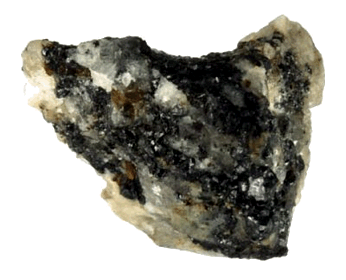
In condensed matter physics, Steinhardt and Dov Levine (Technion) predicted a
new form of
matter, known as a "quasicrystal." This is a solid that exhibits five-fold and
other symmetries
that are impossible for ordinary crystals. He pioneered studies of their
physical and structural
properties and is currently investigating their application to photonics. He has
edited two books
on the subject, The Physics of Quasicrystals and Quasicrystals: The State of the
Art.
feynman.princeton.edu
Articles on KurzweilAI.net written by Paul J. Steinhardt
He constructed the first workable model of
inflation and the theory of how inflation could produce seeds for galaxy
formation. He was also among the first to show evidence for dark energy
and cosmic acceleration, introducing the term "quintessence" to refer to
dynamical forms of dark energy. He made leading contributions to
inflationary theory and to our understanding of the origin of the
matter-antimatter asymmetry in the Universe. Hence, the authors not only
witnessed but also led firsthand the revolutionary developments in the
standard cosmological model caused by the fusion of particle physics and
cosmology in the last 20 years.
edge.org
u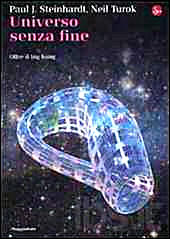 niverso senza fine niverso senza fine
Sebbene la teoria del Big Bang sia la più accreditata per
spiegare 1'origine dell'universo, negli ultimi trent'anni è stata costantemente
rivista e integrata per rispondere alle domande sulla nascita delle galassie e
sulla velocità di espansione dell'universo. Eppure, il quesito più importante,
cosa scatenò il Big Bang, non ha ancora trovato una risposta. In UNIVERSO SENZA
FINE
"Universo senza fine" i fisici teorici Paul J. Steinhardt e Neil Turok
presentano un nuovo modello di cosmologia, affrontando il Big Bang non come un
momento germinale nella storia dell'universo, ma come un passaggio nell'infinita
serie di collisioni tra il nostro e un universo parallelo; Un "universo ciclico"
il cui modello si avvale dei più recenti sviluppi nella ricerca sulla fisica
delle particene e della teoria delle superstringhe.
lafeltrinelli.it
Paul J. Steinhardt è professore di Fisica e Astrofisica
all’Università di Princeton. Ha contribuito a integrare la teoria dell’Universo
inflazionario e ha introdotto concetti come la quintessenza. È noto soprattutto
per il suo lavoro sulla teoria dell’Universo ciclico, presentata in questo
volume.
macrolibrtarsi.it
universo senza fine
-
presentazione luca sabatino
TEORIA DELlE STRINGHE
La cosa
interessante è che siamo già a un livello di sensibilità sufficiente da
iniziare a mettere sotto pressione la teoria della costante cosmologica .
Non dobbiamo aspettare che sia in gioco la nuova tecnologia, siamo già in
gioco.
-pjs
clara
moskowitz - lescienze.it - 2018
The Cyclic Universe
www.kurzweilai.net/the-cyclic-universe
https://paulsteinhardt.org
Quintessence
and the Missing Energy Problem
Recent
evidence suggests that the total matter density of the universe
is significantly less than the critical density. The shortfall
may be explained by curvature (an open universe), vacuum energy
density (a cosmological constant), or quintessence (a
time-evolving, spatially inhomogeneous component with negative
pressure). In all three cases, a key problem is to explain the
initial conditions required to have the energy density nearly
coincident with the matter density today. A possible solution is
?tracker fields,? a form of quintessence with an attractor-like
solution which leads to the same conditions today for a very wide
range of initial conditions. Tracker field make quintessence a
more viable candidate for the missing energy component and
produce more distinctive predictions.
physica.org
physicsweb.org
iop.org
http://it.wikipedia.org/wiki/Quintessenza
Cosmologists have proposed that
a mysterious substance called quintessence can explain why our universe is
accelerating. But what is it made of?
A revolution is taking place in cosmology. New ideas are usurping traditional
notions about the composition of the universe, the relationship between geometry
and destiny, and Einstein's greatest blunder. As numerous observations and
experiments reshape the field, many cosmologists are exploring the possibility
that the vast majority of the energy in the universe is in the form of a
hitherto undiscovered substance called "quintessence".
Quintessence has the striking physical characteristic that it causes the
expansion of the universe to speed up. Most forms of energy, such as matter or
radiation, cause the expansion to slow down due to the attractive force of
gravity. For quintessence, however, the gravitational force is repulsive, and
this causes the expansion of the universe to accelerate.
The name has historical precedents. In philosophy, quintessence refers to the
fifth element - after air, earth, fire and water - proposed by the ancient
Greeks to describe a sublime, perfect substance. In literature, Quintessence is
the queen of a land of speculative science in Rabelais' Gargantua.
In cosmology, quintessence is a real form of energy distinct from any normal
matter or radiation, or even "dark matter". Its bulk properties - energy
density, pressure and so forth - lead to novel behaviour and unusual
astrophysical phenomena. So far its existence has only been inferred indirectly
from a range of observations, but a number of current and planned experiments
will make direct searches for this elusive form of energy.
Although cosmological quintessence bears some superficial resemblance to the
historical version, there is plenty of substance in the modern invocation of
this classical name.
physicsweb.org
paul j. steinhardt
A Quintessential Introduction to Dark Energy
the royal society
MATERIA
OSCURA - dark matter
Perché è così difficile individuare
la materia oscura?
Perché è sfuggente.
Si tratta di una sostanza impalpabile
ed elusiva di cui però vediamo gli effetti in maniera conclamata. Fanno capire
che c'è qualcosa che interagisce gravitazionalmente con la materia ordinaria, ma
ogni tentativo di avvistarla direttamente finora è fallito. Ci si prova da 30
anni, con esperimenti sempre più complessi e sensibili. La nostra è una ricerca
diretta, cioè cerchiamo la particella tramite il segnale che dovrebbe lasciare
nell'apparato strumentale, ma si sta provando a trovarla anche in altri modi. Al
Cern di Ginevra, LHC la cerca ipotizzando la creazione di nuove particelle
nell'acceleratore. Inoltre si cercano dei segnali cosmici, che potrebbero essere
una traccia indiretta di interazioni particolari che la materia oscura potrebbe
subire.
Il problema è diventato talmente
complesso che lo si sta affrontando su tre fronti diversi.
Gioacchino Ranucci - coordinatore nuovo esperimento DarkSide-50 dei Laboratori
Nazionali del Gran Sasso dell'Infn
andrea bettini - rainews.it - 2015
www.focus.it/scienza/spazio/materia-oscura
|