https://youtu.be/5e1VeGCjm0o - https://youtu.be/lcYEtfoc0H8 -
Milva canta Brecht -
Surabaya Johnny - Piccolo Teatro - 2008
.
LA CANZONE DELLA MOLDAVA
In fondo
alla Moldava vanno le pietre sepolti a Praga riposan tre re
. A questo mondo niente rimane
uguale la notte più lunga
eterna non è .
Si mutano i tempi, l'inutile
lotta di galli violenti futuro non
ha . I folli progetti di tutti
i potenti si oppongono invano
al tempo che va .
In fondo alla Moldava vanno le
pietre sepolti a Praga riposan tre re
. A questo mondo niente rimane
uguale la notte più lunga
eterna non è . album brecht di milva - trad giorgio strehler
.
I CATTIVI TEMONO LE TUE UNGHIE I BUONI SI
RALLEGRANO DELLA TUA GRAZIA UN COSA COSÌ MI PIACEREBBE SENTIRE DEI
MIEI VERSI 1951 DIE SCHLECHTEN FÜRCHTEN DEINE KLAUE DIE GUTEN FREUEN SICH DEINER
GRAZIE DERLEI HÖRTE ICH GERN VON MEINEM VERS brecht amava l'arte cinese
- scrisse questi versi
osservando un leoncino
intagliato da radici della pianta del the
.
della qualifica di emigrante Sempre mi è parso
erroneo
il nome che ci hanno dato: emigranti
. Questo significa :
espatriati .
Ma noi non siamo espatriati volontariamente altro paese scegliendo . E nemmeno siamo espatriati in un paese, per restarvi, possibilmente per sempre . Siamo fuggiti, invece .
Espulsi noi siamo,
banditi . E non casa, ma esilio dev’essere il paese
che ci ha
accolti . Così, inquieti,
prendiamo stanza
se possibile presso ai confini aspettando il giorno del ritorno
qualsiasi minimo
cambiamento oltre il confine
spiando, ogni nuovo venuto
febbrilmente interrogando
nulla dimenticando e a nulla rinunciando e neanche perdonando nulla di quel che è successo
nulla perdonando . Ah, il
silenzio del Sund non ci inganna ! Noi
udiamo le grida fin qui, dai loro campi di concentramento . Noi stessi
siamo quasi come voci dei
misfatti, che varcano i
confini . Ognuno di noi che va
attraverso la folla con le sue scarpe consunte testimonia della vergogna che ora macchia il nostro
paese Ma nessuno di noi rimarrà qui . L’ultima parola non è stata ancora detta . 1937 - sund
: tratto di mare tra danimarca e svezia
.
la vita
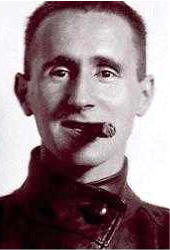
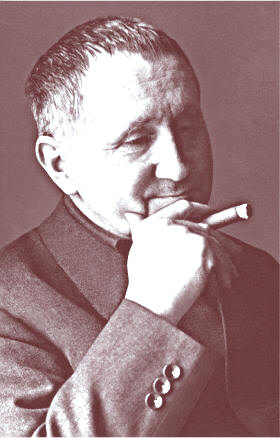
Brecht è il principale drammaturgo tedesco
del Novecento. Nato nel 1898 ad Augsburg (Baviera) scoprì
presto il suo
amore per il teatro. Il suo esordio in teatro era fortemente influenzato
dall'Espressionismo, ma presto aderisce allo schieramento marxista e
sviluppò la teoria del "teatro epico" secondo cui lo spettatore
non doveva immedesimarsi, ma era invitato a tenere una distanza critica
per riflettere su quello che si vedeva in scena. Canzoni, elementi
parodistici e una sceneggiatura molto ben studiata dovevano creare un
effetto di straniamento, un distacco critico. Lo spettatore doveva
imparare qualcosa. Il suo teatro offriva una grande varietà di storie e
casi umani, oppure rivisitazioni di drammi storici che sapevano incantare
il pubblico per la loro arguzia, modernità e impostazione scenica. Per le
sue idee marxiste doveva, nel 1933, emigrare in America, raggiunta
via Danimarca e Mosca (dove si guardò bene di restare). Quando tornò in
Germania, nel 1949, fondò a Berlino Est un proprio teatro, il "Berliner
Ensemble", dove cercò di realizzare le sue idee, portando questo
teatro a una delle più affermate compagnie teatrali. Nonostante le sue
convinzioni marxiste era spesso in contrasto con le autorità della
Germania dell'est.
Morì nel 1956 a Berlino.
brecht and clarinet
munich octoberfest
1920-1921
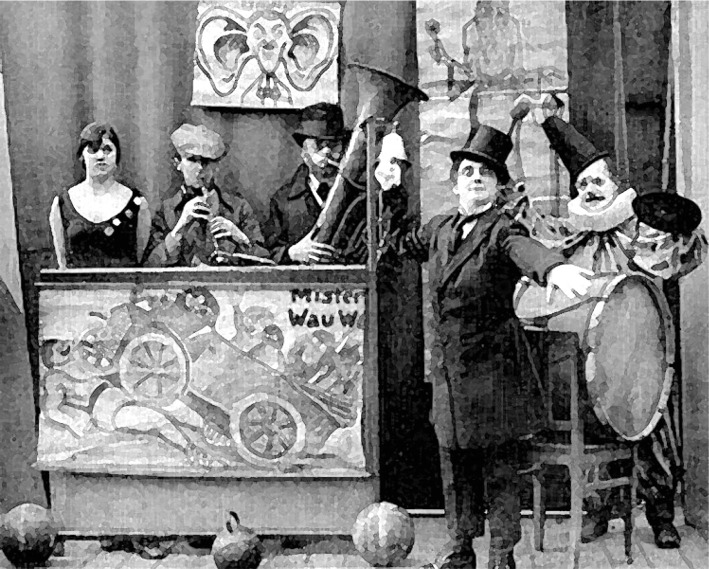
l'opera da tre soldi
La prima di questa opera nel 1928 fu il più grande successo teatrale degli
anni venti. Il pubblico era entusiasta,
l'opera rimase in scena per un intero anno. Che opera però! I personaggi
principali sono il re dei mendicanti che organizza il "lavoro"
dei mendicanti come un affare qualsiasi (e si arricchisce parecchio), il
criminale senza scrupoli Mackie Messer che in fondo è un esempio di
rispettabilità borghese, il capo di polizia che è corrotto fino al osso.
Una sceneggiatura spettacolare, colpi di scena, canzoni e ballate (tra
queste molte delle più più famose della sua intera produzione) scritte
dal compositore Kurt Weill (1900-1950), assicuravano il divertimento
del pubblico. Era un successo e allo stesso tempo uno scandalo: la
differenza tra criminali e persone rispettabili
sparisce del tutto in questa opera, i soldi rendono tutti uguali, cioè
corrotti. Tutto si concentra nella esclamazione
i uno dei protagonisti: "la pappatoria viene prima, la morale dopo!" E
persino il borghese rideva, vedendo
questa "Opera da tre soldi", anche se se forse alla fine gli rimaneva
l'amaro in bocca.
le poesie
Brecht è autore di numerose poesie, tra le più toccanti della lirica
tedesca novecentesca. La sua scrittura poetica è
diretta, con il tono della semplice annotazione immediata, della
confessione di un intellettuale in un età di
atroci crudeltà. Vuole essere utile, non ci porta in nessun mondo
fantastico o enigmatico. Eppure ha un
fascino, una bellezza a cui è difficile sottrarsi. Le sue poesie non hanno
la rima, hanno però un ritmo molto
ben studiato. Nella pagina seguente potete leggere dieci poesie di Brecht
in lingua tedesca e italiana:
Le opere
teatrali più importanti
di Bertolt Brecht
La legge è fatta esclusivamente per lo sfruttamento di coloro che non la
capiscono
o ai quali la brutale
necessità non permette di rispettarla l'opera da tre soldi
- atto III scena 1
Prima di tutto fateci
mangiare, poi, se volete, potrete parlare
Voi che godete a spese
del nostro disonore, date ascolto, sappiatelo, è così
solo saziato l’uomo può
farsi migliore
macheath II, III - secondo finale - l'opera da tre soldi -
die dreigroschenoper
.
coro finale opera da tre soldi Sull’ingiustizia piccola non
v'accanite : presto da sé,
nel proprio gelo, sarà estinta . Meditate la tenebra e l'inverno di questa valle percossa dal pianto . Su, in campo, contro i grandi ladri,
ora e tutti quanti
schiantateli e subito .
Vien da loro la tenebra e l'inverno . Per loro è questa valle sempre in pianto . poesie e canzoni - 1961 traduzione ruth leiser e franco fortini
COLPIRE L'UOMO PER SCREDITARNE
L'OPERA - Bertolt Brecht e i suoi diffamatori
Elisabeth incontra Brecht nel 1924.
E'
bella, colta, parla diverse lingue. Sarebbe stata lei a scrivere dall'80 al
90 per cento dell'Opera da tre soldi. Senza questa collaboratrice, sempre a
quanto afferma John Fuegi, non avrebbero visto la luce neppure Santa
Giovanna dei Macelli, Un uomo è un uomo e varie pièces didattiche. Altre tre
collaboratrici avrebbero scritto in realtà buona parte dei testi teatrali di
Brecht: la berlinese Margarete Steffin, la danese Ruth Berlau
e la finlandese Hella Wuolijoki. La Vita di Galileo sarebbe dovuta in
larga misura all'opera di Margarete Steffin, morta di tubercolosi nel 1941 a
Mosca. Ruth Berlau sarebbe l'autrice del Cerchio di gesso del Caucaso,
mentre Hella Wuolijoki avrebbe fornito, con il suo racconto Un Bacco
finlandese la trama de Il signor Puntila e il suo servo Matti. Perché tutte
queste donne si sono sacrificate per il loro maestro fino a morirne (come
Margarete Steffin), a cadere nell'alcolismo e nella depressione (è il caso
di Ruth Berlau, perita tragicamente nell'incendio di un ospedale
psichiatrico nel 1974), o a tentare il suicidio (come Elisabeth Hauptmann) ...
ilportoritrovato.net
Director's Notes
It was Bertold Brecht's secretary
who first read John Gray's "A beggar's opera" and translated it for him. Brecht was delighted by the story about gangsters, beggars and whores and set about
adapting the play. He soon asked Kurt Weill, with whom he had already worked, to
write some incidental music to accompany the text. Such gems as 'Mack the knife' and 'Pirate Jenny' were a result of this contribution, but it was not until they
sent the play to Ernst-Josef Aufricht, a young actor who had decided to become a
producer, that they found someone ready to take a gamble on their story which
was a patchwork of styles. One week before the play opened no one believed in its success. There were constant cast changes; Rosetta Valletti, who played Mrs
Peachum was so confident that the play would fold in a matter of days that she
signed a contract with another production, and Aufricht was desperately looking
around for a play that he could put on instead of "The Threepenny Opera".
It was Bertold Brecht's secretary
who first read John Gray's "A beggar's opera" and translated it for him. Brecht was delighted by the story about gangsters, beggars and whores and set about
adapting the play.
He soon asked Kurt Weill, with whom he had already worked, to
write some incidental music to accompany the text. Such gems as 'Mack the knife'
and 'Pirate Jenny' were a result of this contribution, but it was not until they
sent the play to Ernst-Josef Aufricht, a young actor who had decided to become a
producer, that they found someone ready to take a gamble on their story which
was a patchwork of styles. One week before the play opened no one believed in
its success. There were constant cast changes; Rosetta Valletti, who played Mrs
Peachum was so confident that the play would fold in a matter of days that she
signed a contract with another production, and Aufricht was desperately looking
around for a play that he could put on instead of "The Threepenny Opera"
...
cities.com
SVENTURATA LA TERRA CHE HA BISOGNO DI EROI
...
La verità riesce ad imporsi solo nella misura in cui noi la imponiamo
la vittoria della ragione non può essere che la vittoria di coloro che
ragionano
...
Amo le consolazioni della carne e non posso soffrire i vigliacchi che le
chiamano debolezze
...
Vita di Galileo
La pace di CATEAU CAMBRESIS (1559) consegna
l'Italia al controllo spagnolo. I funzionari spagnoli amministrano
direttamente il Regno di Napoli, quello della Sardegna, il Ducato di
Milano e lo Stato dei Presidi sulla costa toscana. Ma subiscono l'egemonia
spagnola anche Genova e il Gran Ducato di Toscana. Solo la Repubblica di
Venezia è ancora in grado di sviluppare una politica autonoma, ma talora è costretta ad appoggiarsi
anch'essa alla Spagna per contrastare l'espansione Turca nel
Mediterraneo (la battaglia di Lepanto
avverrà nel 1571).
Quanto allo Stato della Chiesa aveva bisogno della Spagna per avvalersi
della sua forza militare e politica nella campagna contro la Riforma
Luterana ed i protestanti.
L'affermazione della Riforma Luterana, il malcontento e le proteste nei
confronti della corruzione della Chiesa avevano indotto una parte
consistente del mondo ecclesiastico e dei semplici fedeli a vedere in un grande concilio l'occasione per
una riunificazione dei cristiani e di una purificazione dei costumi religiosi.
Nel 1545 indetto da Papa Paolo III si aprì il Concilio a Trento, al
confine con il mondo germanico sperando ancora in una generale
riconciliazione.
Il Concilio segnò soprattutto il trionfo di quella parte della Chiesa che
mirava a porre un argine all'espansione della Riforma Luterana e a
combattere inflessibilmente l'eresia e si risolse più in una complessa ristrutturazione della Chiesa di tipo organizzativo che in un profondo
rinnovamento.
Il Concilio di Trento (1545-1563), approvando la "Professio Fidei
Tridentinae" (1564) e il "Catechismo ROMANo" (1566), definì in modo rigido
il confine tra verità ed errore, lecito ed illecito.
Per imporre il primo aspetto e
liquidare il secondo la Chiesa si servì del "braccio secolare" offerto dalla Spagna (alleanza tra Trono e Altare) ed istituì organismi di severo
controllo: la "Congregazione del Santo Uffizio", che poteva
intervenire direttamente in tutti gli Stati cattolici che ne accettavano
il tribunale per reprimere ogni forma di devianza o di eresia e la
"Sacra Congregazione dell'Indice", che esercitava una censura
repressiva sulle pubblicazioni a stampa attraverso la concessione
dell
'"Imprimatur" e la compilazione dell' "Indice dei libri proibiti".
Il Concilio di Trento individuò anche con chiarezza, le linee portanti
della impalcatura culturale, religiosa, filosofica, scientifica a cui la
Chiesa doveva appoggiarsi. L'Aristotelismo e il Tomismo divennero la
dottrina ufficiale della Chiesa.
Quindi si confermò che la "Verità" già si conosce: è espressa nella Sacra
Bibbia e rivelata dagli autori insigni (Aristotele, San Tommaso).
Si conferma così l'ossequio all' "Ipse Dixit" (lo ha detto l'autore)
e alla capacità di conoscenza della realtà, della deduzione (dall'universale
al particolare).
I Filosofi, gli Scienziati hanno come compito solo quello di trovare le
prove di una Verità che già si conosce; tutto quello che non concorda con
la Verità conosciuta è falso ed eretico.
La Chiesa post-tridentina mette in atto un'organizzazione capillare della
società allo scopo di controllarla ideologicamente, di uniformarla,
organizzandone il consenso non solo ad un insieme di dottrine e di regole,
ma ad un complessivo modello di vita e di condotta
Strumento specifico per ottenere questo consenso, fu l'intervento diretto
della Chiesa sull'educazione familiare e scolastica e la proposta di una
nuova pedagogia: alla pedagogia del gioco degli Umanisti si contrappose la pedagogia
della sorveglianza basata sul precetto "tutto deve essere appreso per regola". Nel campo della scuola fu decisiva l'azione dei
GESUITI, ordine fondato nel 1534, che attraverso i loro collegi per quasi
due secoli formeranno le classi dirigenti europee e giunsero rapidamente a
controllare l'educazione di tutto il mondo cattolico. Contemporaneamente nella prima metà del 1500 (il
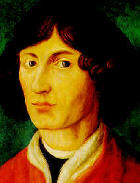
"De revolutionibus" fu pubblicato nel 1543) Copernico "esponeva a Roma la
sua ipotesi davanti a un uditorio di 2000 persone:
"il sole occupa il centro del nostro sistema planetario,
intorno ad esso si aggirano Mercurio, Venere, la Terra, Marte, Giove e
Saturno, ed il tutto è terminato dal cielo delle stelle fisse.
I Pianeti vanno da occidente a oriente e la luna gira attorno alla Terra, la
quale cotidianamente si rivolge intorno al suo asse"
Leopardi "Storia dell'astronomia"
Si narra che il martedì grasso
del 1632 nelle piazze d'Italia girava questa stornellata popolare il saggio Galileo
diede un'occhiata al cielo e disse "Nella Genesi non c'è nulla di
vero !" bel coraggio ! Non è cosa da poco oggi queste eresie si
diffondono come malattie . Che resta se si cambia la Scrittura ?
Ognuno dice e fa quel che gli comoda senza aver più paura . Se certe
idee fan presa gente mia cosa può capitare ? Non ci saran più
chierici alla messa le serve il letto non vorranno più fare ...
Brutta storia ! Non è cosa da poco il libero pensiero è
attaccaticcio come un epidemia . Dolce è la vita l'uomo
irragionevole e tanto per cambiare far quel che ci talenta è assai
piacevole ! Pover uomo che dall'età remota obbedisce
al Vangelo e a chi governa e porgi l'altra gota per conquistar la
ricompensa eterna per obbedire più diventa saggio . è tempo ormai di
vivere ciascuno a suo vantaggio . Mentre il cantastorie si ferma ecco
apparire un fantoccio di grandezza superiore all'umana Galilei che
si inchina verso il pubblico . Davanti a lui un bimbo porta una
gigantesca Bibbia aperta dalle pagine cancellate e il cantastorie
riprende " ecco Galileo Galilei l'ammazza-Bibbia ! "
vita di galileo
ips.it
chi non conosce la
verità è soltanto uno sciocco
ma chi conoscendola la chiama bugia è un criminale ! vita di galileo
1963 - teatro 1994 -
scena 9
.
Galileo: Le città sono
piccole, le teste altrettanto. Piene di superstizioni e di
pestilenze . Ma ora noi diciamo : visto che così
è, così non deve rimanere . Perché ogni cosa si muove, amico mio
... Molto è già stato trovato ma quello che è ancora da
trovare, è di più . E questo significa altro lavoro per le nuove
generazioni . ...
galileo : ... Per tutti i diavoli,
vedo bene che sono ricchi di divina pazienza ma la loro
divina furia, dov'è ? FULGENZIO :
Sono stanchi . GALILEO
: - gettandogli un fascio di
manoscritti - Sei o non sei un fisico, figlio mio ?
Qui sta scritto com'è che negli oceani avvengono le alte e le
basse maree . Non lo puoi leggere, hai capito
? To', e invece lo leggi ?
Sei un fisico, allora ?
...
Finché l’umanità continuerà a brancolare nella sua nebbia
millenaria di superstizioni e di venerande sentenze, finché sarà
troppo ignorante per sviluppare le sue proprie energie, non sarà
nemmeno capace di sviluppare le energie della natura che le
vengono svelate . Che scopo si prefigge il vostro
lavoro ? Io credo che la scienza possa proporsi
altro scopo che quello di alleviare la fatica dell’esistenza
umana . Se gli uomini di scienza non reagiscono
all’intimidazione dei potenti egoisti e si limitano ad
accumulare sapere per sapere, la scienza può rimanere fiaccata
per sempre, ed ogni nuova macchina non sarà fonte che di
nuovi triboli per l’uomo . E quando, con l’andar del
tempo avrete scoperto tutto lo scopribile, il vostro progresso
non sarà che un progressivo allontanamento dall’umanità .
Tra voi e l’umanità può scavarsi un abisso così grande che ad
ogni vostro eureka rischierebbe di rispondere un grido di dolore
universale .
...
GALILEO
Non tiratemi in ballo le difficoltà ! Neanche
la peste ha potuto fermarmi, quando facevo le mie rilevazioni.
... Non c'è reazionario più implacabile dell'innovatore
fallito, non c'è nemico degli elefanti selvatici più crudele dell'elefante
addomesticato . vita di galileo - 1963
Ci sono molti modi
di uccidere una persona
Gli si può infilare un coltello
nella pancia
togliergli il pane
non guarirlo da una malattia
ficcarlo in una casa inabitabile
massacrarlo di lavoro
spingerlo al suicidio
farlo andare in guerra
etc
Solo pochi di questi modi
sono proibiti
nel nostro Stato
gesammelte werke 1967 postumo
l'analfabeta politico Il peggiore
analfabeta
è l’analfabeta politico.
Egli non sente, non parla, nè s’importa degli avvenimenti politici. Egli non sa che il costo della vita,
il prezzo dei fagioli, del pesce, della farina,
dell’affitto, delle scarpe e delle medicine
dipendono dalle decisioni politiche.
L’analfabeta politico è così somaro
che si vanta e si gonfia il petto
dicendo che odia la politica.
Non sa l’imbecille che dalla sua
ignoranza politica nasce la prostituta,
il bambino abbandonato,
l’assaltante, il peggiore di tutti i banditi,
che è il politico imbroglione,
il mafioso corrotto,
il lacchè delle imprese
nazionali e multinazionali.
Per il semplice fatto che si verifica
di frequente
l’ingiustizia assume spesso il volto della giustizia
1898
February 10, born in Augsburg to a paper manufacturer
1904-1908
elementary school (Volksschule)
1908-1917
high school (Königlich-Bayerisches
Realgymnasium)
1913
writes first texts (diaries, school journal); friendship with Paula
Banholzer
1917
matriculates as medical student at Ludwig-Maximilian Universität
in Munich; attends Artur Kutscher's seminars on theater
1918
military service as medical orderly in Augsburg; activity in a
soldiers' council (Soldatenrat) during the November Revolution
1919
drama reviews; Baal, participates in Karl Valentin's
political cabaret; his first son, Frank, is born to Paula Banholzer
1920
first short trip to Berlin; Brecht's mother dies
1921
second trip to Berlin, attends rehearsals of Max Reinhardt and
other major directors
1922
Trommeln in der Nacht (Drums in the Night) opens in Munich
at the Kammerspiele and later at the Deutsches Theater in Berlin; Brecht
receives the prestigious Kleist prize for young dramatists; friendship
with Arnolt Bronnen, marriage with Marianna Zoff
1923
Im Dickicht der Städte (In the Jungle of the Cities)
opens at the Residenztheater in Munich; Baal opens in Leipzig;
collaboration with Lion Feuchtwanger in Munich; his daughter Hanne is
born to Marianne Zoff
1924
Brecht moves to Berlin; Leben Eduards des Zweiten von England
(adaptation of Christopher Marlowe's Edward the Second,
together with Lion Feuchtwanger) opens under Brecht's direction at the
Kammerspiele in Munich; meets Helene Weigel, who bears his son Stefan;
begins collaborative work with Elisabeth Hauptmann;
1925
friendship with the heavyweight boxer Paul Samson-Körner, the
painter George Grosz, and the novelist Alfred Döblin; substantial
writing for journals and newspapers (short stories, essays)
1926
Mann ist Mann (Man Equals Man) opens in Darmstadt
1927
Hauspostille (Manuel of Piety) appears; radio production
of Mann ist Mann and Brecht's adaptation of Macbeth;
first collaboration with Kurt Weill on the Mahagonny song cycle
(starring Lotte Lenya); cooperation with Erwin Piscator's experimental
stagings; divorce from Marianne Zoff
1928
Die Dreigroschenoper (The Threepenny Opera) opens at the
Theater am Schiffbauer Damm in Berlin, becomes the most successful play
of the Weimar Republic
1929
Das Badener Lehrstück vom Einverständnis (The Baden
Cantata of Consent) and Lindbergflug (later renamed Ozeanflug,
Ocean Flight) with music by Paul Hindemith and Kurt Weill, Brecht's
first two "learning plays" (Lehrstücke); meets Walter
Benjamin; marriage with Helene Weigel; Die heilige Johanna der
Schlachthöfe (Saint Joan of the Stockyards, broadcast on radio in
1932); Berliner Requiem (Berlin Requiem) with music by Kurt
Weill broadcast
1930
Aufstieg und Fall der Stadt Mahagonny (The Rise and Fall
of the City of Mahagonny) opens at the Leipzig opera (picketed by Nazis);
Der Jasager und der Neinsager (He Who Said Yes, He Who Said No)
directed by Brecht in Berlin; daughter Barbara born by Helene Weigel; Die
Maßnahme (The Measures Taken) opens in Berlin; "Geschichten
vom Herrn Keuner" (The Keuner Stories); "Die Beule" (The
Bruise), screenplay for the Threepenny Opera Film (not realized)
1931
Mann ist Mann (starring Peter Lorre) directed by Brecht in
Berlin; Brecht and Weill sue Nero Film for breach of contract in the
G.W. Pabst production of the Threepenny Opera film (Brecht
loses, settles out of court, and Weill wins);
1932
Die Mutter (The Mother, adapted from Maxim Gorki's novel),
directed by Brecht and Emil Burri, opens in Berlin; the film Kuhle
Wampe (with Slatan Dudow, Ernst Ottwalt, Hanns Eisler) opens in May
after a censorship scandal; Die Rundköpfe und die Spitzköpfe (Round
Heads and Pointed Heads); friendship with Margarete Steffin
1933
Brecht flees with his family to Zurich after the burning of the
Reichstag (February 27) and then settles in Denmark (Svendborg) with
Weigel and the two children Stefan and Barbara; Sieben Todsünden
(The Seven Deadly Sins) with music by Weill opens in Paris and travels
to London; works on the poetry anthology "Svendborger Gedichte"
(first published in Copenhagen in 1939); friendship with Ruth Berlau
1934
Brecht and Hanns Eisler in London; work on
Der
DreigroschenROMAN (The Threepenny Novel)
1935
travel to Moscow where he meets Sergei Tretiakov, Sergei Eisenstein,
and the Chinese actor Mei Lan-Fan; travel to New York City for the
production of Mother; Furcht und Elend des Dritten Reiches
(Fear and Misery of the Third Reich)
1936
trip to New York City and London
1937
trip to Paris; Die Gewehre der Frau Carrar (Seqora Carrar's
Rifles) opens in Paris under the direction of Slatan Dudow and starring
Helene Weigel
1938
in Paris 8 scenes from Furcht und Elend are staged in German
under the direction of Slatan Dudow and starring Helene Weigel; first
version of Leben des Galilei (Life of Galileo) completed
1939
Brecht and family forced in April to move to Stockholm, Sweden,
with the growing Nazi pressure on neighboring Denmark; Brecht's father
dies; Was kostet das Eisen? (What's the Price of Iron) staged by
Brecht and Ruth Berlau in Stockholm; Mutter Courage und ihre Kinder
(Mother Courage and Her Children) completed, opens in Zurich in 1941,
starring Therese Giehse
1940
Brecht and family forced to move to Finnland by the advance of the
Nazis, first to Helsinki and later to the country estate of the writer
Hella Wuolijoki; Der gute Mensch von Sezuan (The Good Person of
Szechwan) completed; first version of Das Verhör des Lukullus
(The Trial of Lucullus) completed; Herr Puntila und sein Knecht
Matti (Mr. Puntila and His Man Matti) written together with
Wuolijoki; writes Flüchtlingsgespräche (Conversations among Exiles)
1941
Brecht, his family, Steffin, and Berlau travel via Moscow and
Vladivostok to San Pedro (the port of Los Angeles); Margarete Steffin
dies of tuberculosis in Moscow; Brecht meets Charles Chaplin and other
Hollywood luminaries, including Fritz Lang; works on Der aufhaltsame
Aufstieg des Arturo Ui (The Resistable Rise of Arturo Ui), first
staged in 1958 in Stuttgart
1942
Brecht meets other German exiles in Los Angeles (Arnold Schönberg,
Theodor W. Adorno, Max Horkheimer, Thomas Mann, etc.); work on
screenplays (including for the Fritz Lang production Hangmen also
Die)
1943
trip to New York City where he meets with Erwin Piscator, Wieland
Herzfeld, Ernst Bloch, George Grosz, W.H. Auden, etc.; work with Lion
Feuchtwanger on Die Gesichte der Simone Machard (The Visions of
Simone Machard) for which the film rights are sold to MGM (never
produced), first staged in Frankfurt am Main in 1957; Schweyk im
zweiten Weltkrieg (Schweyk in the Second World War) completed,
first staged in German in Erfurt, 1958
1944
Der kaukasische Kreidekreis (The Caucasian Chalk Circle)
completed, first staged in English (in Eric Bentley's translation) at
Carleton College in Minnesota in 1948 and in German by Brecht himself at
the Berliner Ensemble in 1954; Brecht and W. H. Auden work on an
adaptation of John Webster's The Duchess of Malfi, opens at the
Barrymore Theatre in New York City in October 1946
1947
opening of Life of Galileo with Charles Laughton in Los
Angeles (translation by Brecht and Laughton), first German staging in
the Kammerspiele in Cologne, 1955; interrogation by the House Unamerican
Activities Committee (HUAC) in Washington, D.C.; Brecht leaves the USA
on the next day for Switzerland
1948
Brecht adapts Sophocles' Antigone (in Hölderlin's
translation) and directs it together with Caspar Neher at the Chur
Theatre, starring Helene Weigel; he is also involved in the production
of Puntila at the Zurich Schauspielhaus; Brecht moves to East Berlin; Kalendergeschichten
(Tales from the Calendar), Brecht's first postwar publication in Germany,
appears
1949
Brecht establishes the Berliner Ensemble (housed at the Deutsches
Theater) and produces Mutter Courage, starring Helene Weigel; Tage
der Commune (Days of the Commune) completed for a Zurich production
(never realized), first staged in Karl-Marx-Stadt (East Germany) in 1957
1950
Brecht becomes an Austrian citizen; Brecht directs the adaptation
of J.M.R. Lenz's Der Hofmeister (The Tutor), prepared by Brecht,
Ruth Berlau, Caspar Neher, Egon Monk and Benno Besson
1953
Brecht is elected President of the German PEN Center;
Turandot
oder der Kongreß der Weißwäscher (Turandot); Brecht completes
the poetry cycle Buckower Elegien (Buckow Elegies)
1954
Berliner Ensemble moves to the Theater am Schiffbauerdamm; first
international tour to Paris where the Berliner Ensemble's production of Mutter
Courage caused a sensation and catapulted Brecht into the position
of the most important European director; Suhrkamp Verlag in Frankfurt am
Main (West Germany) and Aufbau Verlag (East Berlin) begin publishing the
edition of Brecht's works
1955
Brecht accepts the Stalin prize in Moscow (he requests that Boris
Pasternak translate his acceptance speech); Berliner Ensemble on tour in
Paris for the second time, with Der kaukasische Kreidekreis;
Brecht falls ill
1956
rehearsals of Leben des Galilei under Brecht's direction
and preparation of the Berliner Ensembles tour to London with that
production; on August 14, Brecht dies of heart failure; on August 17, he
is buried in the Dorotheenfriedhof in Berlin
wiu.edu/users/brecht10
Die Gewehre der Frau Carrar Anche qui il protagonista, una
povera madre di famiglia, vuole salvare il proprio “pezzo di
pane”, cioè, fuor di metafora, il figlio, cercando di impedire
che si unisca alle armate partigiane che combattono contro
Franco. Alla base di questa sua difesa c’è un sanissimo amore
materno: ella ha già perso il marito in una guerra che lei non ha
deciso e che non le ha giovato in niente. Per scelta, la signora
Carrar decide di mantenersi neutrale, non consegnando ai
partigiani né il figlio né delle armi che tiene nascoste in casa.
La domanda che percorre il dramma dalla prima all’ultima pagina è
quella sul senso che può avere il combattere contro
un’ingiustizia; Brecht fa dire ad un lavoratore:
Und wie sie stellten ebenfalls die Frage WOZU KÄMPFEN?
viele ihresgleichen sehr lange, fast bis zuletzt. Und daß sie diese Frage so
lange stellten, das war einer der Gründe dafür, daß wir geschlagen wurden, seht
ihr. Und wenn ihr vielleicht in eurem Land diese Frage einmal stellen werdet wie
sie, wozu kämpfen gegen die Unterdrückung, dann werdet auch ihr geschlagen
werden
Non è un caso che questa citazione dal prologo di Frau
Carrar sia del 1939.
Questi sono proprio gli anni cruciali per il vecchio continente, così in bilico
tra pace e guerra; Brecht sente di dover intervenire, sente di dover chiamare
alla resistenza soprattutto quegli studiosi che stanno mettendo il loro sapere
al servizio della pazzia visionaria di Hitler. È quindi in questo periodo che
l’autore comincia a dare sistematicità al materiale sul Galileo, raccolto,
pensato e abbozzato in oltre un lustro di esilio. Galileo assurge a simbolo
della lotta alla violenza, della resistenza “dall’interno”; egli è colui che si
piega per non spezzarsi, che, secondo la leggenda popolare, trasforma l’abiura
in un’astuzia per poter continuare la propria battaglia.
utenti.multimania.it
E
voi imparate
che occorre vedere
e
non guardare in aria
occorre agire e non parlare
Questo mostro
stava una volta per governare il mondo!
I
popoli lo spensero
ma
ora non cantiam vittoria troppo presto
il grembo da cui
nacque è ancor fecondo
la resistibile ascesa di Arturo Ui - 1941
Luna! Pallida luna, che trasognata vai per
gli ampi cieli
della sera, oh dimmi, di’ a quest’uomo ingiusto
da quanto tempo sogni, da quante eternità ?
E quali cose hai visto in notti profonde e silenziose ?
Diafana luna, raccontami, racconta al ribelle appassionato
da quanto tempo sorgi sopra monti, boschi e valli,
lassù in silenzio, come un pallido, solitario campanaro,
lassù, altissima, paziente in eterno?
Hai visto forse nottetempo tragici volti esangui
angosciati dal dubbio se vivere ancora,
hai visto uomini avvinazzati
succhiare le ultime gocce di elisir ? Luna, tu che sai com’era allora,
luna, oh ne sono certo,
tu piangi !
RICORDO DI MARIE A.
Un dì nel mese azzurro di
settembre Quieto
all’ombra di un giovane susino Tenevo il quieto e pallido amore mio Fra le mie braccia come un dolce sogno . E su di noi nel bel cielo d’estate C’era, ed a lungo la guardai, una nuvola . Era assai bianca e alta da non credere E quando la cercai non c’era più. Dopo quel giorno molte e molte lune Con tante acque sono corse via. Sono i susini già tutti recisi E dell’amore, mi chiedi, che fu ? E ti rispondo: non me ne ricordo. Eppure, credi, so che cosa intendi : ma quel viso, io, non lo so più . Questo soltanto so: che la baciai . E anche il bacio, l’avrei dimenticato Non fosse per la nuvola che andava . Quella so ancora e sempre la saprò : era assai bianca e mi veniva incontro Sono forse i susini ancora in fiore forse il settimo figlio
già quella donna avrà . Ma pochi istanti fiorì quella nuvola E quando la cercai era già vento . 1924
Generale il tuo carro armato
è una macchina potente
Spiana un bosco
e sfracella cento uomini.
Ma ha un difetto:
ha bisogno di un carrista.
Generale, il tuo bombardiere è potente.
Vola più rapido d’una tempesta
e porta più di un elefante.
Ma ha un difetto:
ha bisogno di un meccanico. Generale, l’uomo fa di tutto.
Può volare e può uccidere.
Ma ha un difetto:
può pensare.
Durante i miei 9 anni alle scuole
superiori
non sono riuscito a insegnare niente ai miei
professori BB
LA LEGGENDA DEL SOLDATO MORTO E SICCOME NON C’ERANO SPERANZE DI PACE DOPO QUATTRO PRIMAVERE
IL SOLDATO TIRÒ LE CONSEGUENZE
DA EROE VOLLE CADERE.
MA LA GUERRA NON ERA ANCORA IN PORTO
PER QUESTO AL KAISER SPIACQUE
CHE IL SUO SOLDATO SE NE FOSSE MORTO
IN ANTICIPO GLI PARVE.
MENTRE L’ESTATE SFIORAVA LE FOSSE
ED IL SOLDATO DORMIVA DI GIÀ
LA COMMISSIONE MEDICO-MILITARE
UNA NOTTE SI MOSSE.
LA COMMISSIONE MEDICA SI SPINSE
FINO AL CIMITERO
DISSEPPELLÌ CON VANGA BENEDETTA
IL DEFUNTO GUERRIERO.
ED IL DOTTORE VISITÒ CON SCRUPOLO
IL SOLDATO O I RESTI DEL SOLDATO.
DICHIARÒ CH’ERA ‘ABILE-ARRUOLATO’
E S’IMBOSCAVA DI FRONTE AL PERICOLO.
IL SOLDATO SI PRESERO CON SÈ
NELLA BELLA NOTTE BLU.
SENZA L’ELMO SI POTEVANO VEDERE
LE STELLE DELLA PATRIA LASSÙ.
ACQUAVITE BRUCIANTE GLI VERSARONO
NELLA SALMA IMPUTRIDITA
DUE INFERMIERE APPESERO AL SUO BRACCIO
E UNA DONNA PER METÀ SVESTITA.
E SICCOME LUI PUZZA DI PUTREDINE
DAVANTI UN PRETE ZOPPICA
E SULLA TESTA GLI AGITA UN TURIBOLO
PERCHÈ NON PUZZI TROPPO.
DAVANTI ALLA BANDA FRA IL CHIASSO DEI PIATTI
SUONA UNA MARCIA BRIOSA.
ED IL SOLDATO, ESPERTO DEL MESTIERE
SCARAVENTA LE GAMBE DAL SEDERE.
IL BRACCIO INTORNO A LUI, FRATERNAMENTE,
DUE SANITARI MARCIANO, SE NO
LUI NELLA MELMA GLI RIPIOMBEREBBE
E QUESTO ACCADERE NON PUÒ.
HANNO DIPINTO IL SUDARIO DEL MORTO DI NERO DI BIANCO DI ROSSO
E GLIELO PORTANO DAVANTI; LO SPORCO
SOTTO I COLORI RIMANE NASCOSTO.
PRECEDEVA UN SIGNORE CON IL FRAK
E LA CAMICIA DURA
COME OGNI BUON TEDESCO CHE SI SA
IL DOVERE NON TRASCURA.
PASSARONO COSÌ TRA IL CHIASSO DEI PIATTI
PER LO STRADALE OMBROSO
ED IL SOLDATO BARCOLLAVA COME
UN BIOCCOLO IN UN GIORNO NEVOSO.
I GATTI E I CANI GRIDANO
E I TOPI NEI CAMPI CON FISCHIO SELVAGGIO
NON SARANNO MAI FRANCESI
SAREBBE PER LORO UN OLTRAGGIO.
E QUANDO I VILLAGGI TRAVERSANO
UN MUCCHIO DI DONNE ERA LÀ
SI CHINANO LE PIANTE. SPLENDE LA LUNA PIENA
E TUTTI GRIDANO HURRÀ.
CON IL CHIASSO DEI PIATTI E GLI ARRIVEDERCI!
E DONNA E CANE E PRETONZOLO !
E IN MEZZO IL SOLDATO MORTO
COME UNO SCIMMIOTTO SBRONZO.
E QUANDO I VILLAGGI TRAVERSANO
NESSUNO RIESCE A VEDERLO
TANTI GLI STANNO IN CERCHIO
CON IL CHIASSO DEI PIATTI E GLI HURRÀ.
TANTI BALLANO E SCHIAMAZZANO INTORNO
A LUI CHE NESSUNO LO VEDE.
E FORSE LO VEDRESTI MA DALL’ALTO
DOVE SPLENDONO SOLO LE STELLE.
LE STELLE NON CI SONO SEMPRE
E L’AURORA SORGE.
MARCIA IL SOLDATO, ESPERTO DEL MESTIERE
VERSO UN’EROICA MORTE.
Tempi duri
in piedi dalla mia scrivania vedo oltre la finestra in giardino il cespo di
sambuco e vi riconosco
qualcosa di rosso e qualcosa di nero e mi ricordo d'improvviso il sambuco della mia infanzia ad Augsburg. Per qualche minuto considero in tutta serietà se debbo andare fino al tavolo a prendere i miei occhiali per vedere ancora le bacche nere sui rami rossi. 1956
Tempi duri per la poesia
Sì, lo so
solo il felice
È amato.
La sua voce
È ascoltata con piacere
La sua faccia è bella.
L'albero deforme nel cortile
È frutto del terreno cattivo
ma
Quelli che passano
gli danno dello storpio
E hanno ragione.
Le barche verdi
e le vele allegre della baia
Io non le vedo.
Soprattutto
Vedo la rete strappata del pescatore.
Perché parlo solo del fatto
Che la colona quarantenne
cammina in modo curvo?
I seni delle ragazze
Sono caldi come sempre.
Una rima in una mia canzone
Mi sembrerebbe quasi una spavalderia.
In me si combattono
L'entusiasmo per il melo in fiore
E il terrore
per i discorsi dell'imbianchino.
Ma solo il secondo
Mi spinge alla scrivania. l'imbianchino =
hitler 1939
A CHI ESITA
Dici
per noi va male. Il buio
cresce. Le forze scemano.
Dopo che si è lavorato tanti anni
noi siamo ora in una condizione
più difficile di quando
si era cominciato.
E il nemico ci sta innanzi
più potente che mai.
Sembra gli siano cresciute le forze.
Ha preso un’apparenza invincibile.
E noi abbiamo commesso degli errori,
non si può negarlo.
Siamo sempre di meno. Le nostre
parole d’ordine sono confuse. Una parte
delle nostre parole
le ha stravolte il nemico fino a renderle
irriconoscibili.
Che cosa è errato ora, falso
di quel che abbiamo detto?
Qualcosa o tutto?
Su chi contiamo ancora?
Siamo dei sopravvissuti, respinti
via dalla corrente? Resteremo indietro
senza comprendere più nessuno
e da nessuno compresi.
O contare sulla buona sorte?
Questo tu chiedi.
Non aspettarti
nessuna risposta
oltre la tua. poesie e canzoni 1959
. A CHI TENTENNA dici
per noi va male Il buio cresce. Le forze scemano.
Dopo che si è lavorato tanti anni
noi siamo ora in una condizione
più difficile di quando
si era appena cominciato.
E il nemico ci sta innanzi
più potente che mai.
Sembra gli siano cresciute le forze, ha preso
una apparenza invincibile.
E noi abbiamo commesso degli errori,
non si può più mentire.
Siamo sempre di meno. Le nostre
parole d'ordine sono confuse. Una parte
delle nostre parole
le ha stravolte il nemico fino a renderle
irriconoscibili.
Che cosa è ora falso di quel che abbiamo detto?
Qualcosa o tutto?
Su chi contiamo ancora?
Siamo dei sopravvissuti, respinti
via dalla corrente? Resteremo indietro, senza
comprendere più
nessuno e da nessuno compresi?
O dobbiamo sperare soltanto
in un colpo di fortuna?»
Questo tu chiedi. Non aspettarti
nessuna risposta
oltre la tua.
Sono
sfuggito agli squali
ho abbattuto le tigri
divorato mi hanno
le cimici